

All-on-6 supports a fixed bridge on six implants instead of four. What the two extra support points genuinely change, what they ask of your bone, and how the choice is actually made.
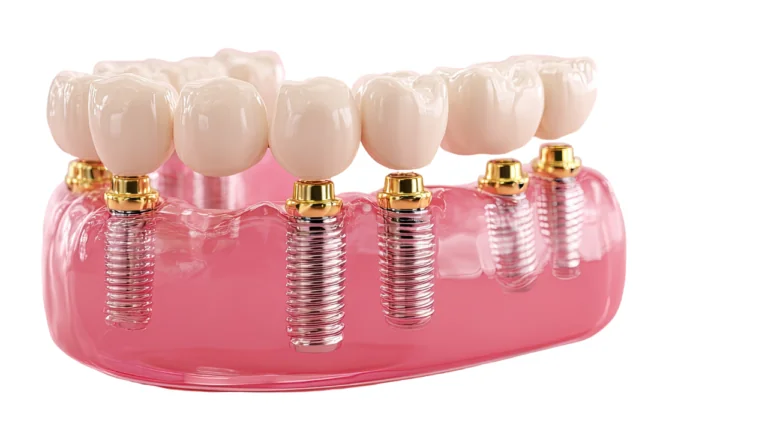
All-on-6 restores a full jaw with a fixed bridge carried by six implants. It shares its logic with All-on-4; the difference is the number of support points, and the biomechanics that follow from it.
There is no simple "more implants is better" answer here. What follows is what the two extra implants actually change, what they ask of your bone, and how the decision is reached.
What Two More Implants Change
Implants carrying a fixed bridge share the chewing load between them. Add support points and the force reaching each individual implant falls, and the distribution across the arch evens out.
The real gain, though, is at the back. In a four-implant design the rear support comes from two angled implants, and the last part of the bridge extends behind that support. With six implants the rear support sits further back, so the unsupported extension is shorter. Shorter extensions mean less leverage on the rear implants when you bite on the back teeth.
The second gain is redundancy. In a four-implant system the loss of one implant affects the whole structure directly. In a six-implant system the remaining support is usually enough to carry the bridge while the situation is dealt with, which changes how a complication plays out.
There is a cost to all of this: more surgical sites, more bone required, and generally a longer procedure. Six implants only help if there is somewhere sound to put all six.
Choosing Between Four and Six
| Situation | Usually favours |
|---|---|
| Bone reduced in the posterior region | All-on-4, using angled placement |
| Bone volume adequate throughout the arch | All-on-6 |
| Strong bite force, history of clenching | All-on-6 |
| A fixed bridge in the opposing jaw too | All-on-6 |
| Keeping surgical time short is the priority | All-on-4 |
| Avoiding a graft is the priority | All-on-4 |
| Long-term redundancy is the priority | All-on-6 |
The third and fourth rows get skipped more often than they should. In someone who grinds their teeth, or in a case where the opposing jaw also carries a fixed bridge, the load on the system rises markedly. Two fixed arches meeting each other generate considerably more force than a fixed arch meeting a denture, because neither side gives. That is a factor that speaks directly to the number of supports.
Notice that the decision is never made on implant count alone. Bone volume, bone quality, the state of the opposing jaw, chewing habits and what you want from the result are all weighed together. A jaw that cannot host six implants without extensive grafting is not improved by insisting on six.
The Treatment Sequence
- Cone beam scan and planning. Every implant position and angle is set in advance on the 3D data.
- Surgery. Extractions where needed, then placement of the six implants.
- Temporary bridge. Fitted the same day where stability allows it.
- Integration. Roughly two to three months for bone to bond with the implant surfaces.
- Final bridge. Made once integration is confirmed, then checked for fit, bite and appearance.
Because six implants mean six sites, the surgical session runs longer than a four-implant one and the first few days of swelling are usually a little more noticeable. Neither of those is a reason to avoid the technique — they are simply things worth knowing before the day rather than after it.
Material Choices for the Bridge
The bridge on top is a separate decision from the implants underneath. Acrylic on a metal framework is lighter and easier to modify. A zirconia bridge is harder, holds its surface better over time and resists staining, but transmits more force to the implants because it does not flex.
That trade-off interacts with the earlier question. A patient with a strong bite is often better served by six implants and a hard bridge material than by four implants and the same material — the support has to match what is being placed on it.
Maintenance
Cleaning is the same discipline as with any fixed full-arch restoration: get under the bridge where it meets the gum, every day. A water flosser or a thin interdental brush does what floss cannot here. Six implants mean more junctions to clean, not fewer.
Reviews matter for the same reason as with any fixed system. Screws are checked, the bite is checked, and the tissue around each implant is assessed. Problems around implants are quiet in their early stages, which is precisely why they are looked for rather than waited for.
Our Position on Cost and Guarantee
We do not publish price lists and we do not give figures before a scan. Whether your case calls for four implants or six, whether any grafting is needed, and which bridge material suits your bite are all things the scan answers. Quoting before that would mean quoting a case we have not seen.
Everything we place is covered by our lifetime guarantee, on materials and on workmanship alike. That guarantee comes from this clinic, not from a supplier, and it has no expiry date attached to it.
The first examination is free, imaging included. Come in and we will show you your own scan, explain what it rules in and what it rules out, and give you a straight answer on which of the two approaches your jaw actually supports. Our clinic is in Bagcilar, Istanbul, open Monday to Saturday, 09:00 to 19:00.