










How the Fixed Subsidy Changes the Question
German statutory health insurance operates a fixed subsidy system for dental restorations. The insurer contributes a set amount based on a standard treatment for your specific finding, and you pay the rest.
The important consequence is that the subsidy does not scale with what you choose. Selecting a more expensive material or a more elaborate restoration increases what you pay, not what the insurer pays.
That makes the patient's own contribution the number that matters, and it is the number most comparisons get wrong by comparing gross figures instead.
It also means the gap between a standard and a premium solution is borne entirely by you — which is precisely where treatment abroad becomes relevant, because that gap is what a lower cost base reduces.
None of this is advice about your own entitlement, which depends on your insurer and your circumstances. It is the framework, and your Krankenkasse is the authority on how it applies to you.
The same logic runs through the material choice. Where a premium ceramic is chosen over the standard provision, the entire difference sits on your side of the ledger — and what actually drives a crown's cost is laboratory time rather than the material itself.
The Bonusheft and Why It Belongs in the Calculation
A feature of the German system with no equivalent elsewhere, and it is worth several percentage points of subsidy to people who have kept it up.
Regular documented check-ups increase the fixed subsidy above the base level, after five continuous years and again after ten. The increase applies to the subsidy rather than to the treatment cost.
So a patient with a complete Bonusheft receives a larger contribution towards the same treatment, which reduces their own share. That is a real amount and it belongs on the German side of any comparison.
It also has a practical implication for anyone considering treatment abroad: keep the check-ups going. Travelling for restorative treatment does not affect the Bonusheft, but stopping routine appointments does.
This is one of the reasons routine care should stay at home regardless. Examinations and hygiene appointments belong with a local dentist, and travelling for them makes no sense at all.
Treatment in Türkiye and the German Festzuschuss
The rules differ between treatment within the EU or EEA and treatment outside it, and this is the point where German patients most often need to check rather than assume.
Within the EU and EEA there are established mechanisms for reimbursement of planned treatment, subject to conditions and frequently to prior approval. Turkey is not in the EU, so those mechanisms do not apply in the same way.
What that means practically is that treatment in Turkey is usually a private arrangement paid in full by the patient, with any reimbursement depending entirely on your insurer's own rules and on prior approval where it is available.
Ask your Krankenkasse directly, in writing, before booking anything. Policies differ between insurers and change over time, and a clinic's summary of German insurance law is not something to rely on — including this one.
Private insurance is a separate question again and depends entirely on your policy. Some cover treatment abroad; many require prior approval, and some exclude it. Read the specific clause rather than assuming either way.
Readers comparing several destinations rather than only Germany will find the same arithmetic applied to Hungary and Poland, both of which are closer to Germany than İstanbul and both of which are the genuine competition on a short flight.
Get the Heil- und Kostenplan First
The single most useful thing a German patient can do before comparing anything, and it is a document you are entitled to.
The Heil- und Kostenplan sets out the proposed treatment, the standard provision, what the insurer will contribute and what you will pay. It is itemised, and it is submitted to your insurer for approval.
That document is what makes a comparison possible. It tells you exactly which teeth are involved and what is proposed for each, which is the information any second opinion needs to be meaningful.
Send it, along with your radiographs, when asking for a quote elsewhere. A proposal built against the same plan is comparable; one built from photographs is not.
It also protects you against the most common error in this decision: comparing two totals for two different treatments. A plan listing each tooth is the only basis on which two proposals mean anything side by side.
Where the Underlying Difference Comes From
The same structural explanation as anywhere, and it is worth stating because it tells you when a figure has stopped making sense.
Salaries, premises, laboratory work and regulatory overhead are all substantially lower in Turkey. A dental practice is a labour business, and a crown is largely technician time.
Materials are not part of that. Implant fixtures, ceramics, bonding systems and grafting materials are globally traded — several of the major implant manufacturers are German, and their products cost a Turkish clinic broadly what they cost a German one.
So the warning is the same: a quote far below the local Turkish market has found a saving the cost base does not provide. Usually the implant system, sometimes the ceramic, frequently an incomplete quote.
The useful comparison for judging a Turkish quote is against other Turkish clinics rather than against German prices, because that is where the cost base is identical and the differences are about what is provided — line by line.
Comparing the Two Proposals
Once you have a Heil- und Kostenplan and an itemised Turkish quote, normalising them takes twenty minutes and frequently changes the conclusion.
| Line | German side | Turkish side |
|---|---|---|
| Teeth involved | Listed in the Heil- und Kostenplan | Should be listed tooth by tooth |
| Insurer contribution | Fixed subsidy, raised by Bonusheft | Usually none — private arrangement |
| Your own share | The number that actually matters | The full itemised figure |
| Implant system | Often named in the plan | Should be named before you pay |
| Ceramic | Standard or premium provision | Should be named specifically |
| Preparatory work | Listed separately | Should be listed separately |
| Travel and stays | None | Add flights, accommodation, trips |
| Guarantee | Statutory remake rules, running two years | Read the written terms |
The third row is the whole comparison. Comparing gross figures rather than your own share is the error that makes this decision look simpler than it is, in either direction.
What the German Side Includes
A fair comparison acknowledges what local treatment provides, and there are real things on that side of the ledger.
Proximity. A restoration needing adjustment at eight months is an appointment rather than a flight. Most post-treatment issues are minor, and distance makes minor issues disproportionate.
Statutory guarantee provisions. German dentists work under defined rules for remaking restorations that fail within a specified period, which is a different mechanism from a contractual guarantee and does not travel.
Continuity. A dentist who has documented your mouth for years knows things that are not in any file, and the Bonusheft depends on that relationship continuing.
None of these argue against treatment abroad. They are components of an honest comparison, and they explain why the answer differs between a full-arch case and a single crown.
Language is a real component too, and it works in both directions. A consultation in your first language produces better decisions, which is why written material in German matters more than a translator being available on the day.
Which Treatments the Arithmetic Favours
The subsidy structure changes this in a specific way that is worth spelling out.
Where the standard provision is close to what you want, the subsidy covers a large share and your own contribution is modest. Travelling to reduce a modest contribution rarely justifies flights and time off work.
Where you want something well beyond the standard provision — implants rather than a removable prosthesis, ceramic rather than a base metal restoration — your own share is large, and that is where a lower cost base makes a real difference.
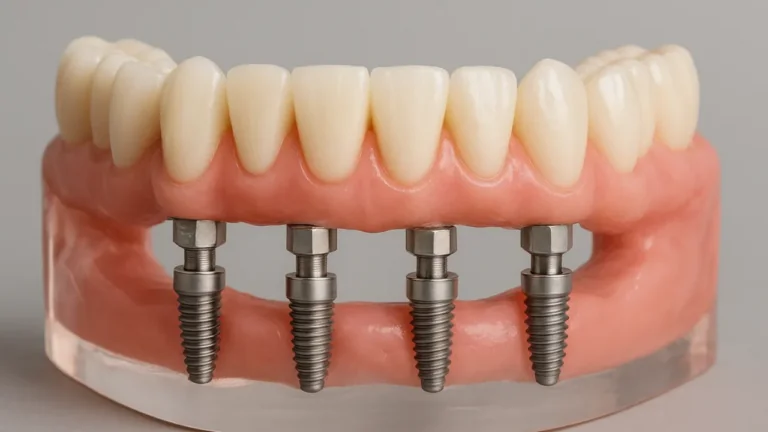
Implants are the clearest case. The statutory contribution relates to a standard solution for the finding rather than to the implant itself, so the patient bears most of the cost — and the comparison with a conventional bridge is worth reading before deciding either way.
Full-arch treatment amplifies the same effect. How a full-arch quote is built shows why the absolute difference grows with the scale of the work.
Practical Points From Germany
Short, because most of the logistics are the same as from anywhere in Europe.
Flights are frequent and direct from every major German airport, and the journey is roughly three to three and a half hours. Turkey is two hours ahead of Germany in winter and one in summer, so there is no jet lag in either direction.
Choose Istanbul Airport (IST) over Sabiha Gökçen where fares are comparable — it is on the European side and considerably closer to Bağcılar, and the difference applies to every transfer of the trip.
German is one of the languages in which clinical conversations and written material are provided, which matters for consent and aftercare rather than for convenience — how that is arranged sets out the detail.
Take the full record set home, including the implant passport. Any German dentist can maintain the work with it, and components are proprietary enough that reconstructing the information later is genuinely difficult.
Plan the trip around the treatment rather than the reverse. Restorative work on a healthy foundation is usually one visit of five to seven working days; implants need two separated by months of integration, and that is two absences from work rather than one.
Aftercare in Germany
Ordinary dentistry, and keeping it going matters more here than in most systems because of the Bonusheft.
Continue your regular check-ups without interruption. Treatment abroad does not affect the Bonusheft; missing appointments does, and the effect compounds over years.
Hygiene appointments continue at the interval you are given, which may be shorter than standard after gum treatment or extensive restorative work.
Minor issues are usually resolved by message with a photograph, or by a short local appointment using the records you were given. Anything covered by the guarantee is handled by us.
Speak to a German dentist about ongoing care before you travel rather than after. Most will provide it willingly, and the maintenance requirements are the same wherever the work was done.
Where implants were placed, the maintenance is specific rather than general. Cleaning around the fixture at the gum margin prevents the inflammation that causes bone loss, and that is what ends implants far more often than anything mechanical.
Interdental brushes sized to your spaces are more effective than floss around implants and bridges. Your own dentist or hygienist can size them at the first appointment after you return.
The Questions Worth Asking Both Sides
The same questions, asked of your German dentist and of any clinic abroad. Comparing the answers is more informative than comparing the figures.
- Which teeth are involved, and what is proposed for each and why?
- Which of them are currently sound and unrestored?
- What is the more conservative alternative, and why was it not chosen?
- Which implant system and which ceramic, by name?
- How many visits, and how far apart?
- What does the guarantee cover, and what voids it?
The second and third questions are the ones that surface over-treatment in either country. A plan that cannot answer them was not built from an assessment.
Where the two plans differ substantially in scope, that is a clinical disagreement worth resolving on its merits rather than by price — and it is usually the more important finding of the whole exercise.
Ask about materials specifically. Which ceramic goes on which tooth has a right answer that depends on position and load, and a plan naming one material for every tooth has not made the decision.
How We Work With German Patients
Send your Heil- und Kostenplan and radiographs before travelling. Working against the same plan is what makes a second opinion meaningful rather than a different proposal for a different treatment.
We quote after imaging rather than from photographs, so the figure does not change after arrival. Every tooth is listed with its material and its reason, and where a tooth is sound we say so along with the conservative alternative.
Where our assessment differs from your German dentist's, we say why rather than simply proposing something different. A disagreement with reasons attached is useful to you; one without them is not.
Clinical conversations and all written material — plan, consent, aftercare, guarantee — are provided in German. Consent given in a language you do not fully control is not consent.
You leave with the full record set including the implant passport, and everything we place carries a lifetime guarantee on materials and workmanship — with the exclusions stated plainly rather than buried.
The Standard Provision Question
This is where German patients most often need a straight answer, because the phrase "standard provision" does a great deal of quiet work in the calculation.
The subsidy is calculated against a defined standard treatment for your particular finding. For a missing back tooth that may be a conventional bridge; for a larger gap it may be a removable prosthesis.
If you want an implant instead, the subsidy stays at the level set for the standard solution and the difference is yours. That is not a penalty; it is how the system is designed, and it is why implant treatment produces the largest own-share figures.
It also means the clinical comparison matters as much as the financial one. Whether a bridge or an implant is right for your particular gap is a question about the neighbouring teeth and the bone, and it has a real answer independent of what either system subsidises.
Work that out first, then price it. A decision driven by which option attracts more subsidy rather than by which is better for the mouth is the wrong way round, in either country.