














Why There Is No Price List on This Page
A dental implant is not a product you buy; it is a surgical outcome that depends on your anatomy. Two people missing the same tooth can need entirely different treatment — one a straightforward placement, the other an extraction, a graft, four months of healing and then a placement.
Publishing a single figure for both would be dishonest to one of them. In practice, headline prices are set for the simplest possible case, and the additions appear later, once flights are booked and the patient is sitting in the chair. That is the mechanism, and it works because the first number felt like a commitment.
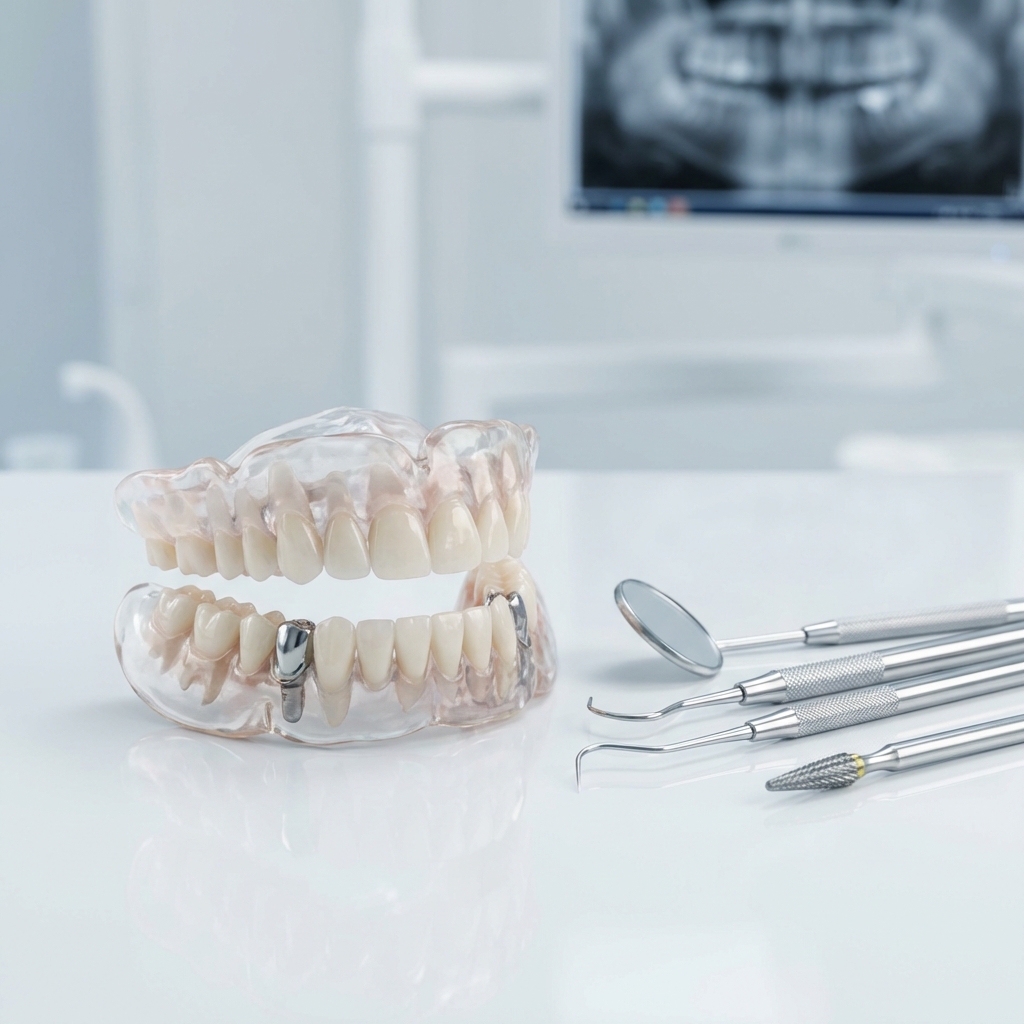
We quote after imaging, not before. A panoramic radiograph shows the existing teeth, roots and gross bone levels; a CT scan shows the bone in three dimensions, which is what implant planning actually needs. Both can be taken at our clinic or sent by your own dentist.
The result is a figure that does not move. If you want to understand what will be in it before you send anything, the rest of this page sets out every line and what changes it.
What an Implant Quote Actually Contains
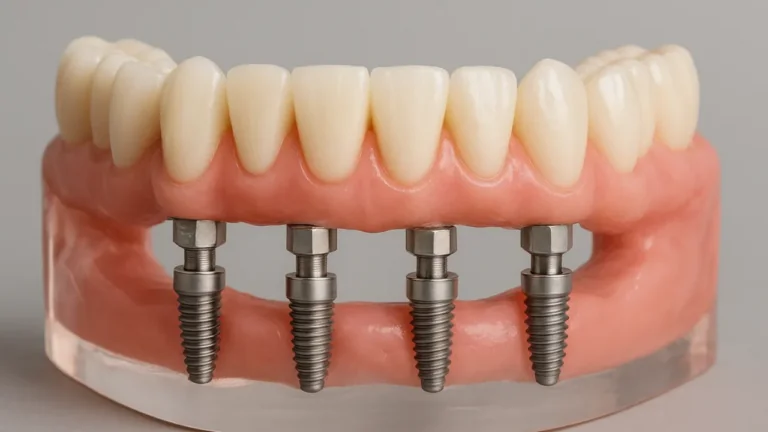
A complete implant restoration has four parts, and they are frequently quoted as one. Knowing the four is the single most useful thing when comparing proposals, because a low total often means one of them has been left out.
- The surgery itself — placement of the fixture, including anaesthesia and follow-up.
- The implant fixture — the titanium post that replaces the root, priced by system.
- The abutment — the connector between the fixture and the crown, stock or custom-made.
- The crown — the visible tooth, priced by material exactly as any other crown is.
A quote that gives one figure per implant without saying whether the crown is included is the most common source of surprise. The fixture alone is roughly half of a finished tooth. If the total looks unusually low, this is almost always why.
Ask for the four lines separately. Any clinic that plans properly already has them itemised internally, and producing them takes no effort.
The Implant System Is the Largest Single Variable
Implants are not interchangeable. There are premium systems with three or four decades of published survival data behind them and worldwide parts distribution, established mid-range systems with solid evidence and good availability, and budget systems with little independent literature and limited distribution.
All are regulated products and all will integrate with healthy bone in most patients. The difference appears years later, when a component needs replacing. A widely distributed system can be serviced by any dentist in any country. An obscure one may leave an implant that is perfectly healthy in the bone and impossible to restore above it.
That is why the system chosen accounts for so much of the spread between quotes, and why the brand belongs in the quote in writing rather than in a conversation. How implant systems actually differ sets out what separates them beyond the marketing.
It is also the one line where paying less has a consequence you will not encounter for a decade — which is precisely what makes it easy to sell short.
The Crown on Top Is a Separate Decision
Once the fixture has integrated, a crown is fitted, and that crown is priced by material like any other. Monolithic zirconia, layered zirconia, and lithium disilicate all behave differently and cost differently, and the right choice depends on where the tooth sits.
At the back, strength matters more than translucency and monolithic zirconia is usually correct. At the front, appearance dominates and a more translucent material earns its place. Quoting the same crown for every position is a sign that no one has thought about it.
The abutment sits between the two and is quietly significant. A stock abutment is machined to a standard shape; a custom one is milled to your gum contour and produces a better emergence profile, which matters most on front teeth. The differences between zirconia types covers the materials in detail.
Screw-retained or cemented is a further choice, and it affects the long term rather than the price. Screw-retained crowns can be removed for servicing without being destroyed, which is worth having on a restoration meant to last decades.
Preparatory Work: Extraction, Grafting and Sinus Lift
This is where quotes diverge most, and it is not padding. Bone resorbs once a tooth is lost, and an implant needs enough bone in three dimensions to be stable. Where there is not enough, it has to be built.
A socket preservation graft placed at the time of extraction is the cheapest form of this by a wide margin, because it prevents the loss rather than reversing it. Where a tooth has been missing for years, a larger graft may be needed, with healing time before placement.
In the upper back jaw the sinus sits above the roots, and after tooth loss it expands downward into the space. A sinus lift restores the height needed. It is common, predictable, and it is the line most often absent from a low quote for upper molars.
Where bone loss in the upper jaw is severe, zygomatic implants can avoid grafting entirely by anchoring into the cheekbone. It is a larger surgery with a narrower set of indications, and it belongs to specialists.
Reading a Complete Quote, Line by Line
The table sets out what a full implant quote should contain and what moves each line. Use it to check what is missing from a proposal, which is usually more informative than what is in it.
| Line item | What it is for | What changes it |
|---|---|---|
| Consultation and imaging | Panoramic radiograph and CT planning | Whether you bring recent imaging with you |
| Extraction | Removing a tooth that cannot be saved | Simple versus surgical removal; number of roots |
| Socket preservation | Preventing bone collapse after extraction | Only relevant if the extraction is done with implants planned |
| Bone graft | Rebuilding lost width or height | How much bone is missing and in which dimension |
| Sinus lift | Creating height in the upper back jaw | Internal versus external approach |
| Implant fixture | The titanium root replacement | The system chosen — the widest variable of all |
| Healing abutment | Shaping the gum during integration | Usually included; ask if it is not listed |
| Abutment | Connecting fixture to crown | Stock or custom-milled to your gum contour |
| Crown | The visible tooth | Material, position in the mouth, screw or cement retained |
| Review and guarantee | Follow-up and written cover | Should not be a separate charge at all |
If a proposal arrives as a single figure, ask for it broken down this way. The request is entirely normal and the answer tells you a great deal.
Why the Number of Implants Is Not the Number of Teeth
One of the most common misunderstandings, and one that makes quotes look wildly different for no reason. Missing teeth do not each need an implant. Implants support restorations, and a restoration can span more than one tooth.
Three missing teeth in a row are commonly restored on two implants with a three-unit bridge between them. A full arch does not need twelve or fourteen implants; depending on bone, it is restored on four, six or eight, with a fixed bridge across them.
That decision is clinical, not commercial. Bone volume, bite forces, whether you grind, and the opposing arch all feed into it. Four implants against six sets out where the line falls, and how full-arch treatment runs covers the sequence.
When comparing quotes, compare the finished result rather than the implant count. A proposal with fewer implants and a well-designed bridge can be both better and more expensive than one with more implants.
Why Two Clinics Quote Differently for the Same Mouth
Assume both are honest. There are still four legitimate reasons the totals differ, and separating them from the illegitimate ones is the whole skill of reading a quote.
- A different implant system, which is the largest and most defensible difference.
- A different number of implants, reflecting a genuine difference of clinical opinion.
- Different preparatory work, where one clinic has planned grafting and the other has not.
- A different crown material or abutment type on top of an otherwise identical plan.
The illegitimate reasons look similar at first glance. Work omitted that will be added later, a crown quoted separately without being mentioned, an unnamed implant system, or a plan that includes teeth that did not need treating.
The way to tell them apart is to lay both quotes out line by line against the table above. Where one has fewer lines, ask why. A clinic with a genuine reason will give it immediately.
What a Very Low Quote Usually Means
Materials are imported into Turkey at world prices. A titanium fixture from an established manufacturer costs a Turkish clinic broadly what it costs a German one. What is genuinely lower here is everything around it — salaries, premises, laboratory work, overheads.
That produces a real and sustainable difference. It does not produce an unlimited one. When a quote sits far below the local market rather than the market you came from, the saving has come from somewhere, and there are only a few places it can come from.
Usually it is the implant system, occasionally the ceramic, sometimes the surgeon's experience, and often simply an incomplete quote that will grow. None of these are visible on the day of treatment, which is what makes the strategy work.
The protection is the same one as everywhere else on this page: get the system named, get the lines itemised, get it in writing before you pay a deposit. The wider set of checks worth making covers the rest.
The Costs That Sit Outside the Quote
Implant treatment is staged, and staging has its own costs. Bone integration takes roughly three to six months, which means more than one trip for most plans. Flights and accommodation for the second visit are part of the real total even though no clinic lists them.
Some plans can be arranged around this. Where a temporary bridge is fitted at surgery, you leave with fixed teeth and return for the permanent work. Where immediate loading is clinically appropriate the timetable shortens, but that is a decision made at surgery on measured stability, not a scheduling promise.
Transfers and accommodation are handled directly by us rather than through an agency, which removes a layer that adds cost without adding anything else — how the arrangements work sets out what is covered.
Aftercare is the cost people forget entirely. A night guard where you grind, and hygiene appointments at the usual interval, are what protect the investment. They are small next to the treatment and they decide how long it lasts.
Long-Term Cost Is the Number That Matters
An implant is the most expensive way to replace one tooth today and frequently the cheapest way to have replaced it over twenty-five years. That inversion is the entire economic argument, and it turns on one fact: implants are not routinely replaced, and the alternatives are.
A bridge has a typical service life measured in years rather than decades, and when it fails the abutment teeth have usually deteriorated underneath, so the replacement is larger than the original. Dentures are relined periodically and remade as the bone continues to resorb beneath them.
Against that, a well-placed implant in a maintained mouth commonly outlasts both by a wide margin. Implants against bridges and implants against dentures set out the arithmetic case by case.
This is also why the guarantee matters more than the headline. Ours covers materials and workmanship for life, on materials and workmanship, in writing, in writing, with the exclusions stated plainly — what that includes is worth reading before comparing any two totals.
How to Compare Two Quotes Fairly
Put them side by side and normalise them before comparing totals. The exercise takes twenty minutes and it is the single most valuable thing you can do at this stage.
- Confirm both include the crown, not just the fixture and abutment.
- Check both name the implant system and manufacturer explicitly.
- Check both name the crown material and whether the abutment is custom.
- Count the implants in each and ask why they differ if they do.
- Look for preparatory work — grafting, sinus lift, extraction — in both.
- Add the number of trips each requires, and the travel that implies.
- Read both guarantees for scope and exclusions, not just duration.
- Ask both what happens if a component fails in ten years.
After that, differences that remain are real differences and you are comparing like with like. Most of the time the exercise closes the gap considerably, and occasionally it reverses which quote is actually lower.
If you are weighing implants against other options entirely, the full range of replacements lays out what each one does and costs over time.
How We Quote at Bağcılar
Imaging first, always. A panoramic radiograph, and a CT scan where implants are planned, before any figure is discussed. If you have recent imaging from your own dentist, send it and we will work from that.
The plan is written tooth by tooth. Each implant is listed with its position, the system, the abutment type and the crown material. Preparatory work is listed separately with its own timeline, so you can see what happens on which visit rather than being given a single week and a single number.
The figure does not change afterwards. If something is found during treatment that alters the plan — and it is uncommon once a CT has been read — we tell you before doing it, not afterwards.
You leave with your imaging, the implant passport recording the manufacturer and lot number of every fixture placed, the material records and the written guarantee. How and when payment is made is set out separately, and nothing is due before the plan is agreed.
What the comparison looks like depends a good deal on where you are starting from, because the thing an implant is being compared against is not the same everywhere. Readers in Britain are usually weighing this against private UK implant fees and what the NHS does and does not cover; readers in Ireland against what Med 2 relief actually returns; readers in North America against an annual insurance maximum that runs out well before a single implant is finished. Each of those pages does the arithmetic for that system rather than in the abstract.