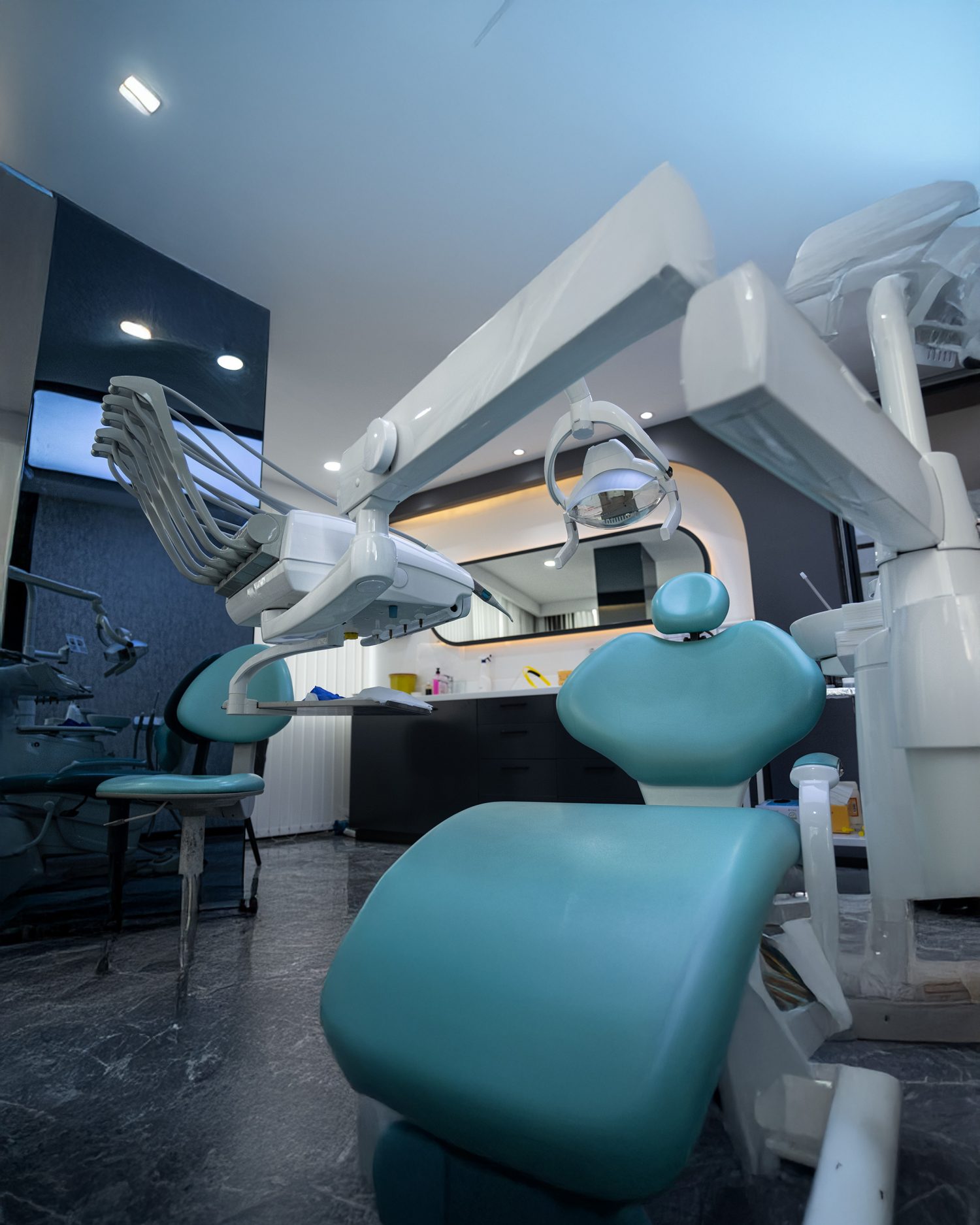
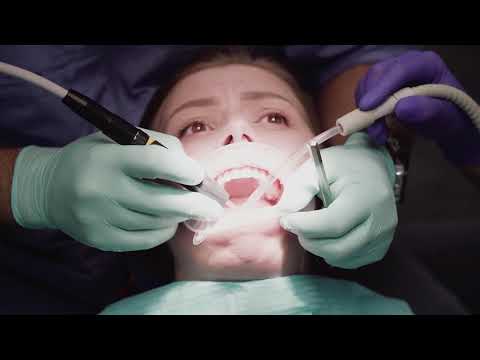
Root canal treatment (endodontics) saves a tooth in which the nerve is inflamed or necrotic due to deep decay, trauma or cracking. Without treatment the risk of tooth loss and abscess is high.
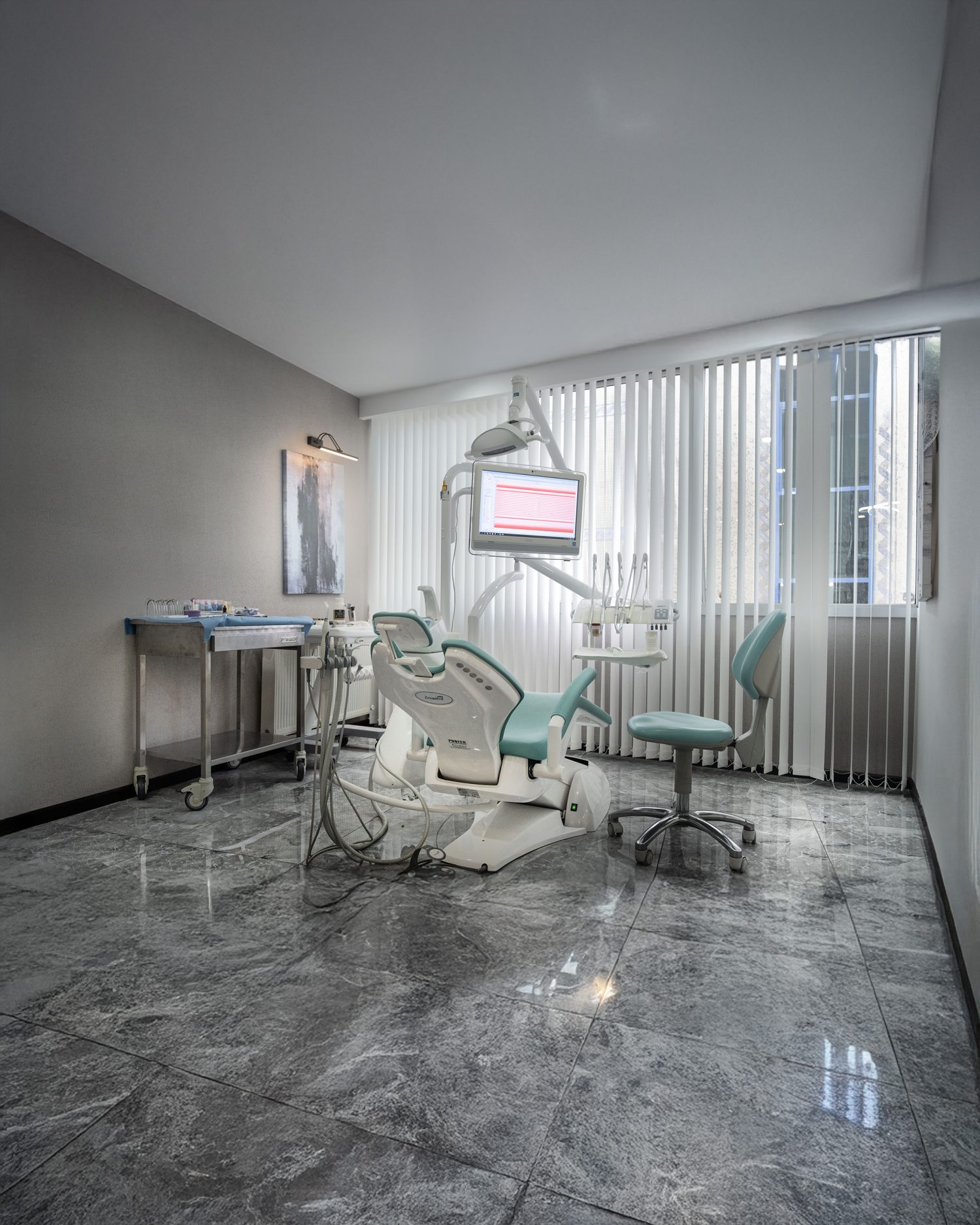
At our clinic, every case is planned with high-resolution 3D X-ray and digital apex locators. Canals are cleaned to microscopic precision, disinfected with advanced antibacterial solutions and sealed with a biocompatible material (gutta-percha).
Local anaesthesia keeps the procedure pain-free — modern protocols make a root canal feel as comfortable as a regular filling. Afterwards the tooth is usually restored with a crown or onlay to protect it from chewing forces.
A properly performed root canal is a highly successful treatment that lets you keep your natural tooth root for many more years. Our goal is to preserve your tooth as long as possible.
What Root Canal Treatment Actually Is
Inside a tooth, protected by the hard tissues, there is a space containing blood vessels and nerve tissue: the pulp. When the pulp becomes inflamed or loses its vitality it does not heal on its own, because it sits in a sealed chamber with no room to swell. That pressure is what produces the pain people associate with root canals.
Root canal treatment removes that tissue, cleans and shapes the canals, and fills the space with a sealing material. The root itself stays where it is; the only thing removed is what was inside it.
So root treatment is a rescue rather than a loss. The alternative is extraction, and whatever replaces an extracted tooth does not do what its own root did. Keeping your own tooth is better than the best implant.
A common question: "If the tooth is dead, why does it hurt?" The pain usually comes not from the pulp but from inflammation spreading from the root tip into the surrounding bone. That is why a non-vital tooth can hurt, and sometimes hurt more.
Which Symptoms Point to Root Treatment
Some symptoms are obvious and some are quiet. The following always need assessing:
Pain that lingers after cold. Ordinary sensitivity fades within seconds of the stimulus being removed. Pain lasting minutes is different.
Spontaneous pain. Pain that arrives without eating or touching anything.
Pain that wakes you at night. Pain that worsens when you lie down is a classic sign of rising pressure.
Pain on biting on one specific tooth. This can indicate that inflammation has reached the root tip.
A blister or discharge on the gum. A chronic abscess draining itself; it needs treatment even without pain.
A tooth that has darkened. Particularly in front teeth that have taken a knock, this indicates loss of vitality.
Facial swelling. This is an emergency and must not be waited out.
There are also symptomless cases, and those are caught on routine radiographs. A dark area at the root tip can reveal an infection the patient feels nothing of — a concrete example of why regular check-ups matter.
One important warning: pain stopping does not mean healing. When the pulp dies completely the pain disappears for a while, but the infection continues to progress in the bone. Some of the teeth postponed because "it passed" come back months later as an abscess or an extraction.
Reversible and Irreversible Pulpitis
Not every inflamed pulp needs a root canal, and this distinction is the single most useful piece of knowledge in preventing unnecessary root treatments.
Reversible pulpitis. Deep decay or a recently placed restoration has irritated the pulp. There is sensitivity to cold, but it resolves quickly once the stimulus is removed. Here the treatment is not a root canal: the decay is removed, the tooth is sealed properly, and the pulp settles by laying down protective dentine. A filling or a crown is enough in that situation.
Irreversible pulpitis. If pain lingers after the cold has gone, arrives spontaneously, or wakes you at night, the tissue can no longer recover. No filling solves that; root treatment is needed.
The boundary is not always sharp, and sometimes observing a tooth for a period is the correct approach. We say so: a decision to wait is also a decision, and its reasoning is explained. Treating an uncertain tooth "just to be safe" applies an irreversible procedure without cause.
Here the distinction is made from the examination, a cold test and radiographs together. The decision rests on what all three describe rather than on any one finding.
How the Treatment Is Carried Out
Anaesthesia. The area is fully numbed. Where inflammation is intense the anaesthetic is supplemented to keep you comfortable; that is a routine adjustment for an experienced clinician.
Isolation. The tooth is isolated from the mouth with a rubber dam. This step should never be skipped: it keeps bacteria in saliva out of the canals and directly affects the success rate.
Access. The pulp chamber is reached through the biting surface.
Cleaning and shaping. The canals are cleaned with appropriate files and shaped to receive the filling material. Working length is measured electronically at this stage.
Irrigation. The canals are flushed with antibacterial solutions. Mechanical cleaning alone is not enough; most of the infection is removed by irrigation.
Obturation. The canals are filled to the apex with a seal.
The restoration on top. The tooth is sealed; posterior teeth usually need cusp coverage.
Some cases finish in one appointment and some need two. Where inflammation is intense or there is discharge, placing medication in the canal and waiting a week is the correct approach. That is part of the treatment, not a delay.
A molar can have four canals, sometimes five. Finding all of them and cleaning each to the apex takes time; a molar root canal finished in forty minutes has been rushed. The price of rushing here is retreatment two years later.
An Honest Answer About Pain
Root canal treatment is the procedure with the most horror stories attached to it in dentistry, and that reputation belongs largely to the past.
With effective local anaesthesia you do not feel pain during the procedure. We do not write that as "painless treatment", because it is a condition rather than a promise: the anaesthetic has to take fully, and in some intensely inflamed teeth that requires a supplementary dose or a different technique. It is normal for your dentist to do that; the only thing you need to say is "I can feel it".
The real pain happens before the appointment rather than during it. Most patients arriving for a root canal have already been in pain for days, and the treatment ends that pain. So the belief that root canals hurt is an inverted relationship: the pain comes from the condition, not from the treatment.
Afterwards there can be mild tenderness for a few days, particularly on biting. That is inflamed tissue settling and it is controlled with simple analgesics. It should decrease steadily; if it increases, or if swelling appears, tell us.
For patients with significant anxiety we offer sedation. We do not treat that as a weakness; if it means a tooth postponed for years finally gets treated, it is the right tool.
Why the Tooth Is Usually Covered Afterwards
Root-treated back teeth are almost always restored with something that covers the cusps. The reason is usually explained with a claim that is not accurate.
The common but wrong explanation: "A root-treated tooth dries out and becomes brittle." The research does not support this; moisture content and dentine hardness are not meaningfully different in root-filled teeth.
There are two real reasons. The first is loss of structure: the access cavity cut for the treatment, plus the large pre-existing decay that usually led to it, removes the walls that held the cusps together. The second is loss of proprioception: with the nerve gone, the mechanism that warns you when the tooth is overloaded goes too. The tooth does not feel that it is taking too much force.
Together those two markedly raise the risk of a crack in an uncovered root-treated molar. Once a crack extends below the gum there is often no way to save the tooth — which makes postponing the crown one of the most common ways to lose it.
Front teeth are different. Where structure loss is limited, a composite restoration can be enough; not every root-treated tooth needs a crown. At the back, cusp coverage is the rule rather than the exception.
Success Rates, and Why Retreatment Is Sometimes Needed
Root canal treatment has a high success rate; the literature reports roughly eighty-five to ninety-five per cent. That makes it one of the more predictable procedures in dentistry.
What determines success: finding every canal, cleaning to the apex, proper isolation, a sound seal, and restoring the tooth without delay. That last item is the one most often skipped — a perfectly executed root filling left under a temporary for months becomes recontaminated by saliva.
Where treatment falls short there is a second chance: retreatment. The old filling is removed, the canals are cleaned again and refilled. Where a missed canal is found, the success rate is high.
If retreatment is not enough there is a surgical option: apicoectomy. The infected area at the root tip is removed through a small surgical procedure. It is the last step in saving the tooth and should always be considered before extraction.
Only when all three have been exhausted does an implant come into the picture — skipping that sequence and going straight to extraction means losing a tooth that could have been kept. The decision, with its reasoning, is written into your plan.
Emergencies and What Must Not Wait
Most dental infections are treated on a planned basis. But some symptoms do not wait for an appointment, and you should know them.
Swelling spreading across the face — particularly towards the eye or down into the neck.
Difficulty swallowing or breathing.
Swelling in the floor of the mouth.
Fever alongside the swelling.
Difficulty opening the mouth.
With any of these, go to the nearest emergency department wherever you are. Do not send a message and wait for a reply; tell us afterwards. These situations are measured in hours, and their rarity does not justify not knowing what to do.
Other pain — unbearable sensitivity to cold, pain that wakes you, pain on biting — needs a same-day dental appointment rather than an emergency department. We try to see patients in pain the same day, so say that you are in pain when you book.
One more warning: antibiotics alone do not resolve a root infection. With no blood supply inside the canal, the drug does not reach it. Antibiotics can reduce swelling temporarily, but the source stays where it is — and because the pain stops, treatment gets postponed. That is the most common cause of delay we see.
Afterwards: Aftercare and What to Expect
What to expect and what not to expect in the days after treatment:
The first days
Symptom
Normal?
What to do
Mild tenderness on biting
Yes, for a few days
Simple analgesics; it should ease
Hot and cold sensitivity
No — the nerve is gone
Report it; it may be another tooth
Increasing pain
No
Book an appointment
Swelling
No
Be seen the same day
Temporary filling comes out
It can
Do not leave it; the canal must not stay open
If the temporary filling comes out, do not wait. An exposed canal becomes recontaminated by saliva and can undo a completed treatment. That matters particularly for patients travelling for treatment, which is why we plan the permanent restoration within the same trip.
In the long run a root-treated tooth needs the same care as any other: brushing twice daily, daily interdental cleaning and regular check-ups. In addition we recommend a radiographic review at six months to a year to follow healing at the root tip.
Like every treatment carried out here, root canal treatment and the restoration over it carry a lifetime guarantee on materials and workmanship. What it covers and what falls outside it — accidental damage, neglect, missed recommended check-ups, delaying the permanent restoration — is set out in writing.
Root Treatment or Extraction?
This is the point at which a patient is most open to being steered, and the direction of that steer varies from clinic to clinic. Our starting position is clear: a tooth that can be saved is saved.
The reason is biological rather than sentimental. Your own root transmits chewing force into the bone naturally, has an established relationship with the gum around it, and holds the neighbouring teeth in position. Whatever replaces an extracted tooth — an implant, a bridge or a denture — does not do all three.
There are cases where extraction is the right answer, and we say so plainly: a vertical root fracture, too little remaining structure to support a restoration, advanced bone loss around the root, or a tooth that is not in a functional position. Insisting on root treatment in those situations spends time and money to reach the same outcome.
The decision is made together over the radiographs. You are told three things: the likelihood of saving the tooth, how much work saving it will take, and what options remain if it cannot be saved. An extraction decided without those three discussed is a decision made too early.
One more point: attempting root treatment does not forfeit the implant option. If it fails, the tooth can still be removed and an implant still placed. Ordering the sequence in the tooth's favour carries no real cost.
Benefits
Lets you keep your natural tooth
Eliminates pain, sensitivity and swelling
Pain-free with modern local anaesthesia
High success rate with digital apex locators
Prevents abscess and the spread of infection
Long-lasting restoration with a crown afterwards
✦ Frequently Asked Questions
Frequently Asked Questions
01Is the procedure painful?
No. Modern local anaesthesia eliminates pain during the procedure. The real discomfort is usually the toothache that brings the patient to the clinic.
02How many sessions does it take?
1–2 sessions are enough in most cases. Larger infections may require up to 3 sessions.
03Is a crown mandatory afterwards?
Yes. Root-treated teeth are more brittle; we strongly recommend a crown or onlay to protect against chewing forces.
04Can the treatment fail?
With the right protocol, the success rate is over 90%. In rare cases retreatment or apical surgery may be needed.
A safe, comfortable and transparent treatment process at every stage with our experienced physicians.
Dt. Muhammed Yancar
Responsible Manager · Dentist
He graduated from Okan University Faculty of Dentistry (2022). He works as the responsible manager and dentist at Bağcılar Dental Polyclinic. He is a member of the Turkish Prosthodontics and Implantology Association (TPİD) and the Turkish Dental Association (TDB).
Dr. Dt. Remziye Kuşağlı
Responsible Dentist
He graduated from Dicle University Faculty of Dentistry (2005); He has 21 years of experience. It specializes in implant-supported dentures, All-on-4/All-on-6, zirconium, laminate and E-max coating treatments. He is a member of TDB.
Uzm. Dr. Dt. Nazlı Altın
Oral and Maxillofacial Surgery Specialist
He graduated from Istanbul University Faculty of Dentistry; He completed his doctorate in oral, dental and maxillofacial surgery. He specializes in complex cases with implant surgery, jaw surgery and bone grafting.
Uzm. Dt. Uğur Derdiyok
Oral and Maxillofacial Surgery Specialist
He graduated from Ankara University Faculty of Dentistry; He completed his specialization in oral, dental and maxillofacial surgery at Kırıkkale University. He is an expert in surgical practices with 11 years of experience.
Uzm. Dt. Ceren Çetinkaya
Orthodontic Specialist
He graduated from Ege University Faculty of Dentistry; He completed his orthodontics specialization at Istanbul University. He is experienced in fixed and transparent plate treatments and focuses on functional and aesthetic results.
Dr. Dt. Hakan Şahin
Pedodontics Specialist (Pediatric Dentist)
He graduated from Atatürk University Faculty of Dentistry; He completed his pedodontics specialization. It has been providing preventive and therapeutic services in children's dental health for many years.
Uzm. Dt. Natiga Israfilova
Prosthetic Dentistry Specialist
He is a graduate of Azerbaijan Medical University; He completed his prosthetic dentistry specialization at Eskişehir Osmangazi University. With 20 years of experience, he is an expert in implant prostheses, All-on-4/6, zirconium, laminate and E-max applications.
Dt. Nur Küçük
Prosthodontics & Digital Dentistry
He graduated from Istanbul Medipol University, Department of Dentistry; He continues his doctoral education in prosthetic dentistry. He works on aesthetic and functional restorations and smile design with CAD/CAM systems.
Dt. Mehmet Emin Ceylan
Implant & Prosthesis
He graduated from Istanbul Aydin University Faculty of Dentistry; He has 7 years of experience. He specializes in implant-supported dentures, All-on-4/All-on-6 restorations, full mouth dentures and zirconium applications.
Dt. Zeynep Demirhan
Prosthodontics & Aesthetic Dentistry
He graduated from Bezmiâlem Vakıf University, Faculty of Dentistry. He is experienced in prosthetic treatments, smile design, implant-supported prostheses and treatments under sedation; focuses on patient satisfaction.
Dt. Seda Şahle Alemdar
Implant & Aesthetics · Digital
He graduated from Abant İzzet Baysal University Faculty of Dentistry (2020). He is experienced in implant-supported dentures, smile design, digital measurement systems and aesthetic restorations.
Dt. Muhammed Ali Almaz
Implant & Aesthetic Dentistry
He graduated from Gazi University Faculty of Dentistry (2021); He has 5 years of experience. He works with health tourism patients in the fields of implant prostheses, All-on-4, zirconium, aesthetic fillings and teeth whitening.
Dt. Berkay Pehlivanoğlu
Restorative & Prosthetic
He graduated from Marmara University Faculty of Dentistry (2021); He has 6 years of experience. He works in the fields of endodontics (root canal treatment), restorative treatments, zirconium/E-max/laminate prosthesis and implant-supported prosthesis.
Dt. Esranur Çelik
Restorative & Periodontology
He graduated from Süleyman Demirel University Faculty of Dentistry (2017); He has 9 years of experience. He works in periodontology (gum), restorative and endodontic treatments and aesthetic smile design.
Dt. Havva Öztürk
General & Restorative Dentistry
He graduated from Bolu Abant İzzet Baysal University Faculty of Dentistry (2023). Works in restorative, endodontic, periodontal, prosthetic and pedodontic treatments; Follows current treatments closely.
Dt. Sümeyya Aydınlık
Dentist
He graduated from Istanbul Yeni Yüzyıl University, Department of Dentistry (2020); Has approximately 5 years of experience. In addition to general dentistry, he works in implant prosthesis, restorative and endodontic treatments.
Dt. Hasip Altun
General Dentistry
He graduated from Yüzüncü Yıl University Faculty of Dentistry (2018). He has clinical experience in general dentistry and restorative treatments; It stands out with its patient-oriented approach.
Dt. Birsen Er
Implant & Aesthetic Dentistry
He graduated from Istanbul University Faculty of Dentistry (2002); He has 24 years of experience. He works in the fields of implant-supported prostheses, All-on-4, zirconium restorations, aesthetic fillings, root canal treatment (endodontics) and teeth whitening.