











The Principle: Single-Use First
The foundation of modern cross-infection control is not sterilisation at all. It is elimination — anything that can be used once and discarded is, because a discarded item cannot transmit anything.
That covers a longer list than most patients realise. Needles, syringes, gloves, masks, suction tips, saliva ejectors, prophylaxis cups and brushes, matrix bands, impression material, surgical drapes, gauze, cotton rolls, and the bib and its chain.
Scalpel blades, sutures and bone graft materials are single-use by definition in surgery. So are the drills used in implant placement in many protocols, since cutting efficiency falls with reuse and a blunt drill generates heat.
What remains is a much smaller set: the handpieces, the hand instruments, the burs where they are reusable, and the surgical instrument sets. Those are what the sterilisation process exists for.
This is why the visible signal matters. Items arriving at the chair in sealed packaging, opened in front of you, is the single most informative thing you can observe in any clinic anywhere.
Impression material is single-use by nature, and digital scanning removes even that. An intraoral scanner uses a sleeved or sterilisable tip and puts nothing into the mouth that sets, which removes a whole category of handling.
The Cycle, Step by Step
Instruments follow a fixed sequence from the moment they leave the chair, and it is one-directional — clean and dirty do not cross.
- Transport in a closed container to a dedicated decontamination area, never carried openly.
- Pre-cleaning to remove visible debris, since sterilisation does not penetrate organic matter.
- Ultrasonic or washer-disinfector cleaning, which reaches hinges and serrations that hand cleaning cannot.
- Rinsing and drying, because residual moisture interferes with the sterilisation cycle.
- Inspection for damage and residual debris — an instrument that fails this is rejected.
- Packaging into sealed pouches with a chemical indicator and a date.
- Autoclave sterilisation at 134°C under pressurised steam.
- Cycle verification, then storage in a clean, dry, dated area until use.
The second step is the one most often underestimated. Steam cannot sterilise what it cannot reach, and organic debris shields whatever is underneath it. Cleaning is not a preliminary to sterilisation; it is a precondition.
The sequence is physically separated in a properly designed decontamination room — dirty in at one end, clean out at the other, with no path back. That layout is what prevents recontamination of processed instruments.
What an Autoclave Actually Does
Steam under pressure at 134°C, held for a defined period. The pressure allows steam to exceed 100°C, and it is the combination of temperature, pressure and time that destroys bacteria, viruses and — critically — bacterial spores.
Spores are the reason the standard is set where it is. Ordinary disinfection kills bacteria and most viruses; spores survive it, and they are the hardest thing to eliminate. An autoclave cycle is defined by what it takes to kill them.
Vacuum-type autoclaves remove air before admitting steam, which matters for hollow instruments and wrapped packs. Air trapped in a handpiece lumen prevents steam contact, and an item that steam did not reach is not sterile regardless of the cycle reading.
Cycles are run against loads, not against instruments individually, which is why load composition and packing matter. Overpacking a chamber prevents steam circulation and produces the same failure.
The machine is the easy part. Every licensed clinic has one. What separates practice is whether each cycle is confirmed to have worked.
Verification: The Part That Matters
An autoclave that fails does not announce it. It completes a cycle, displays a reading and produces instruments that look identical to sterile ones. Verification is what closes that gap.
| Check | What it confirms | How often |
|---|---|---|
| Cycle printout or log | Temperature, pressure and time reached for that load | Every cycle |
| Chemical indicator on each pouch | That pouch was exposed to sterilising conditions | Every pouch, every time |
| Chemical indicator inside packs | Steam penetrated to the centre of a wrapped set | Every wrapped surgical pack |
| Air removal test | The vacuum stage is working, so steam can reach lumens | Daily, before the first load |
| Biological indicator | Live spores were actually killed | Periodically, logged |
| Maintenance and validation | The machine performs to specification | Scheduled, by engineer |
The chemical indicator is the one you can see. It changes colour when the pouch has been through sterilising conditions, and it should be visible on the pouch as it is opened at your chair.
The biological indicator is the searching test, because it uses living spores and confirms they were killed. Asking how a clinic verifies each cycle is the most useful sterilisation question — the daily air-removal test and the log for every load are the European standard, and periodic biological indicator testing, the American convention, is a further layer on top.
What You Can Observe Yourself
More than most people expect, and none of it requires knowing anything about dentistry.
- Instruments arriving in sealed pouches, opened in front of you rather than before you sat down.
- A visible chemical indicator on the pouch that has changed colour.
- Gloves put on after hand hygiene, in front of you, and changed between patients.
- A new pair of gloves after the clinician touches anything outside the treatment field.
- Barriers on the light handle, chair controls and computer keyboard, replaced between patients.
- The chair, bracket table and spittoon wiped down between patients.
- A new bib, new suction tip and new cup for you specifically.
- For surgery: sterile drapes, sterile gowns and instruments opened at the chair.
The pouch is the most informative of these. An instrument laid out on a tray before you arrived may be perfectly sterile and you have no way to know; one opened in front of you needs no trust at all.
Barriers on touched surfaces are the second. Light handles and chair controls are handled constantly during treatment, and a clinic that barriers them has thought about the parts nobody looks at.
None of this is intrusive to watch, and no reasonable clinic minds being observed doing it. Being watched is part of the point.
One more worth watching for on a restorative visit: try-in stages. A crown or veneer tried in your mouth and then returned to the laboratory is decontaminated before it goes, and that back-and-forth is routine rather than exceptional in careful work.
Water Lines: The Part Nobody Mentions
Dental units deliver water through narrow tubing, and stagnant water in narrow tubing forms a biofilm. It is a genuine infection-control consideration and it is rarely discussed anywhere.
The management is routine where it is done: lines flushed at the start of the day and between patients, a disinfection protocol on a schedule, and periodic water testing to confirm it is working.
For surgery the requirement is different again. Implant placement uses sterile saline delivered from a sealed bag through a sterile line, not unit water, because the site is bone rather than an intact mouth.
You can observe part of this: lines being flushed between patients is visible, and a sterile saline bag on a stand during implant surgery is unmistakable.
It is a good question to ask precisely because it is obscure. A clinic that answers it fluently is running a system rather than a routine.
It matters more for some treatments than others. Surgical procedures bypass unit water entirely, while ultrasonic scaling uses it directly against tissue that is already inflamed — which is where line quality has the most contact with a patient.
Surgical Standards Are Different
Implant placement, grafting and sinus procedures are surgery, and the standard steps up accordingly rather than continuing as normal treatment with extra instruments.
A sterile field is established: sterile drapes over the patient, a sterile instrument tray, and everything within that field either sterile or not touched. The point is isolating the surgical site from anything that has not been processed.
The team gowns and gloves sterilely after a surgical scrub. That is different from ordinary clinical gloves and hand washing, and it is visible — you will see it happen.
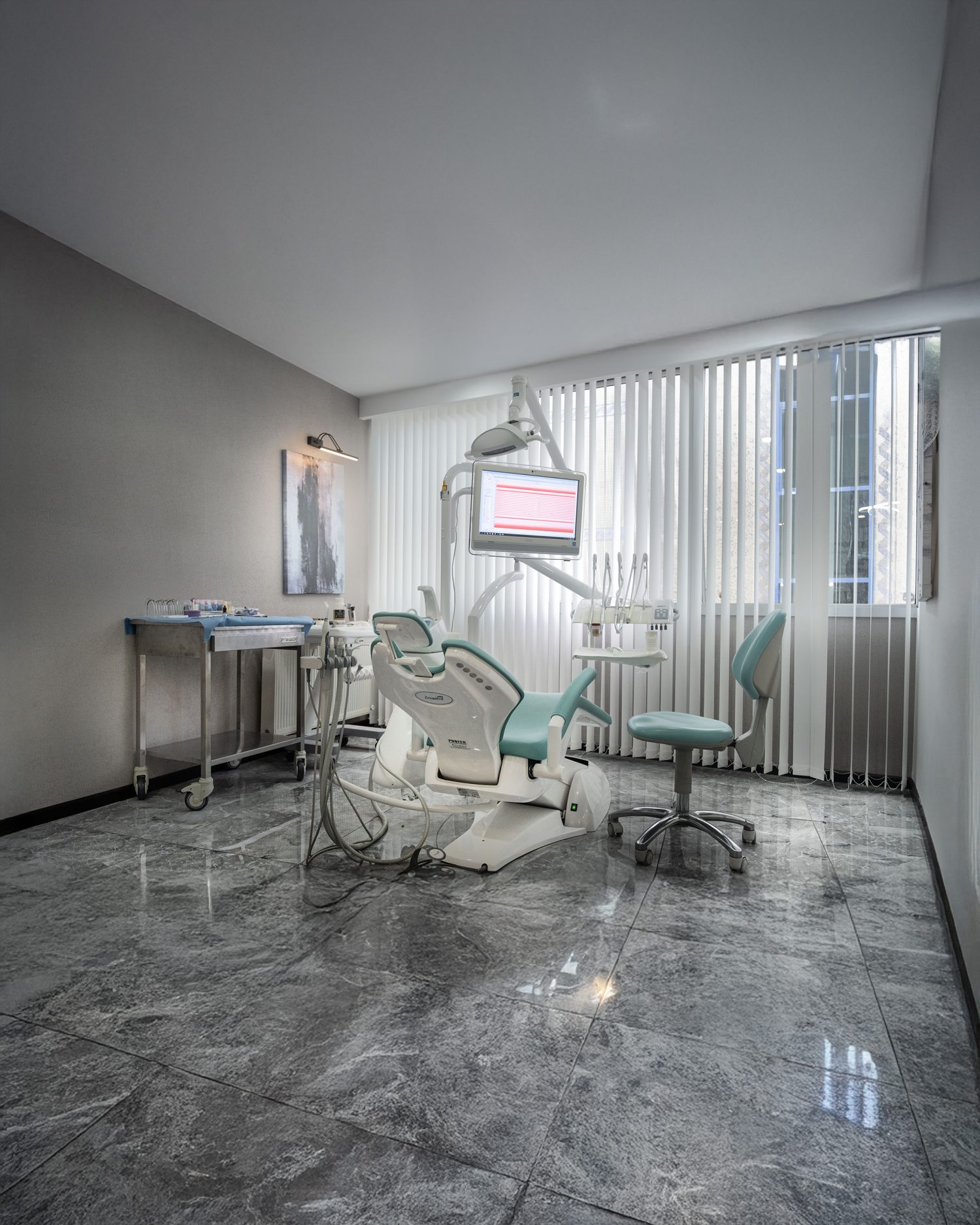
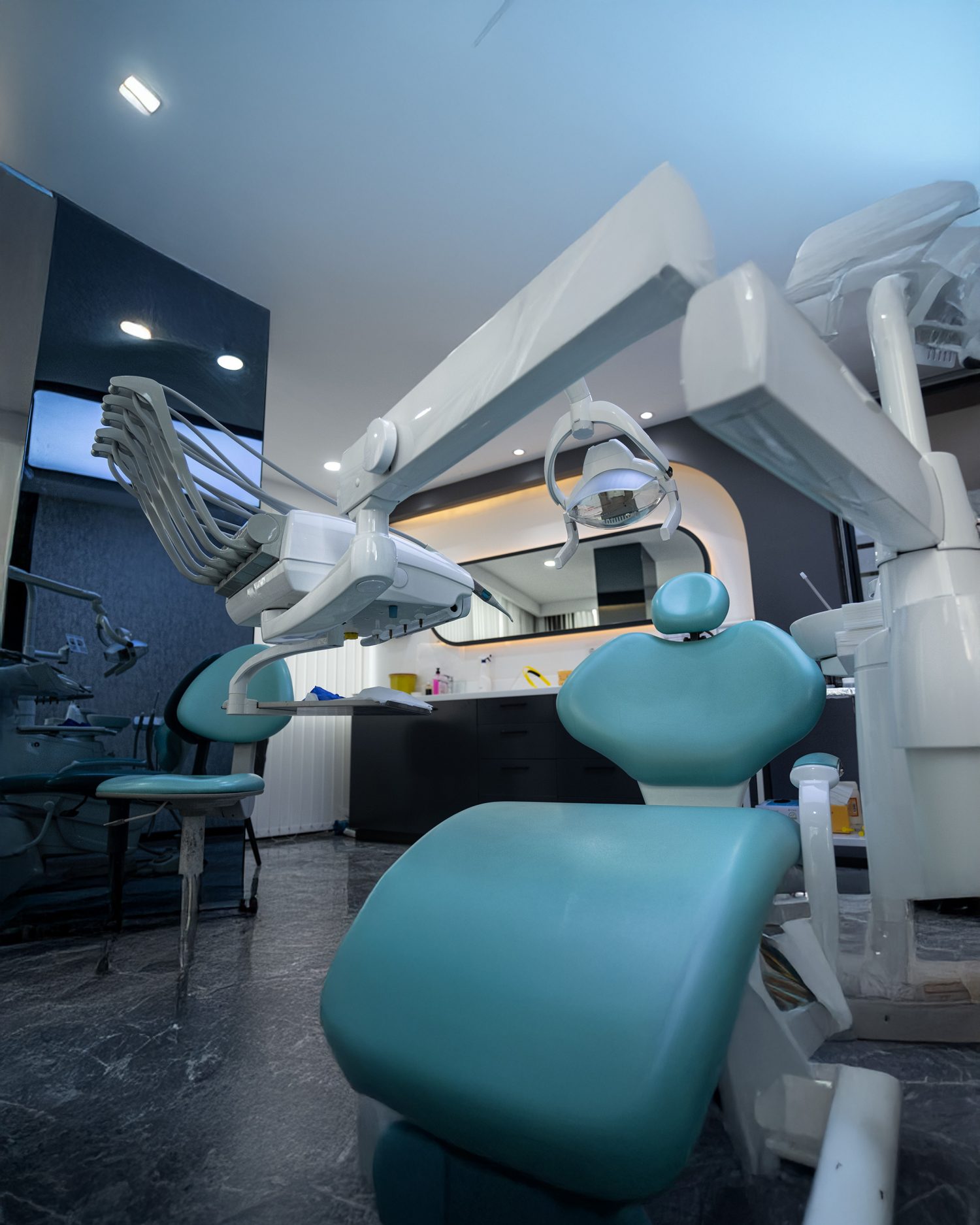
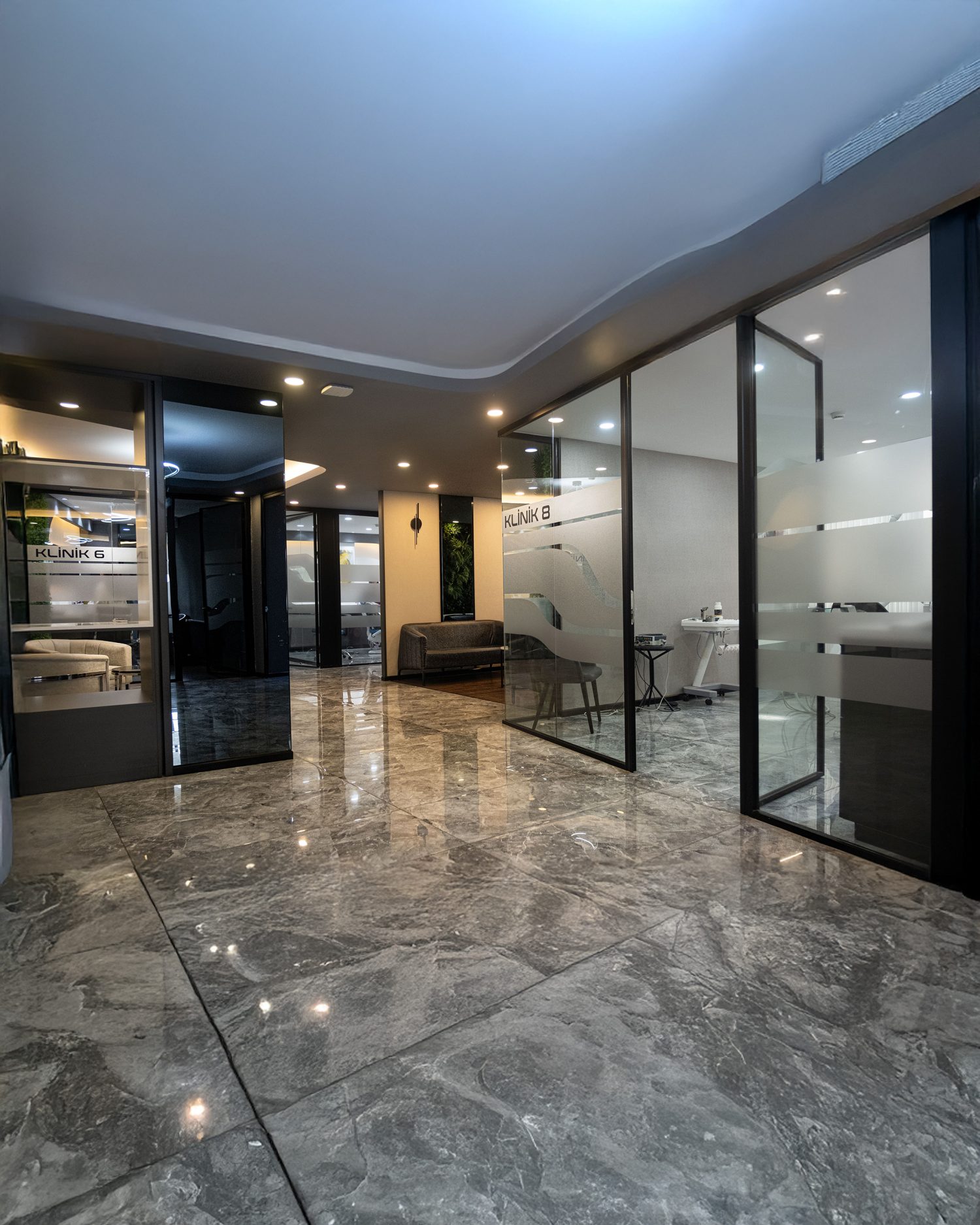
A separate surgical room rather than a general treatment bay reduces airborne contamination and allows the setup to be prepared without competing with a check-up schedule. The surgical setup is described alongside the rest of the equipment.
Sterile saline irrigation, controlled drill speed and torque, and single-use drills where the protocol requires them complete the picture. Overheated bone does not integrate, and that is a technique issue as much as a sterility one.
The same standard applies to grafting materials and membranes. Both arrive sterile in sealed packaging opened within the field, and what is placed is recorded in your notes along with lot numbers, exactly as implant components are.
Waste, Sharps and Handling
Downstream of treatment and largely invisible to patients, which is exactly why it is worth describing.
Sharps go into rigid, sealed containers at the point of use — never recapped by hand, never passed, never left on a tray. Needlestick injury is the main occupational hazard in dentistry and the protocol exists for the team as much as the patient.
Clinical waste is segregated from general waste and disposed of through a licensed route. Extracted teeth, blood-contaminated materials and single-use surgical items all fall into that stream.
Amalgam waste is separated and captured rather than entering the water system, which is a mercury handling requirement rather than an infection one.
Staff immunisation, particularly hepatitis B, is part of the same system. It protects the team and, through them, the patients — and it is a reasonable thing to ask about.
Extracted teeth are worth a note because patients often ask. They are clinical waste and are disposed of through the licensed route, though a tooth can usually be returned to you on request if it has been decontaminated — ask before the extraction rather than afterwards.
Where Standards Actually Vary
Being honest about this is more useful than asserting that everything is identical everywhere, because it tells you what to check.
The equipment does not vary much. Autoclaves are autoclaves and licensed clinics have them. What varies is process discipline: whether every pouch is indicated, whether biological testing is actually run and logged, whether barriers are genuinely changed between patients on a busy day.
Volume is the pressure point. A clinic running a high patient throughput has more opportunity for a step to be compressed, and the steps that get compressed are the invisible ones.
That is not an argument against busy clinics. It is an argument for the observable signals — sealed pouches opened at your chair, visible indicators, barriers changed — because those are the steps that cannot be quietly skipped while you are watching.
It also connects to the broader point about this whole subject: sterilisation is checkable, and the risks that are not checkable — over-treatment and compressed timetables — deserve proportionally more of your attention.
Timetable pressure is the specific version of this that matters in health tourism. A plan compressed to fit a flight puts pressure on every step behind the scenes, which is one more reason a realistic timetable is a quality signal rather than an inconvenience.
Questions Worth Asking Any Clinic
Five, all answerable in seconds by a clinic that runs a system. The fluency of the answer matters as much as its content.
- Do you use chemical indicators on every pouch?
- How often do you run biological indicator tests, and are they logged?
- Do you run a daily air removal test on the autoclave?
- What is your water line disinfection protocol?
- For implant surgery, is a separate surgical room used with sterile drapes and gowns?
The second is the best single question. It is specific, it has a factual answer, and a clinic that does not run biological testing will struggle to answer it smoothly.
The fourth is the one almost nobody asks, and the answer separates clinics that have thought about infection control from those that have bought equipment for it.
None of these are confrontational. They are ordinary operational questions, and a clinic that treats them as an insult has given you an answer of a different kind.
Ask them at the consultation alongside the clinical questions rather than as a separate interrogation. A first appointment covers a great deal, and these fit naturally into it — as does asking to see the licence and authorisation documents while you are there.
What Is Reused, and Why That Is Fine
Worth addressing directly, because "reused" sounds alarming and the reality is unremarkable.
Hand instruments — mirrors, probes, excavators, forceps — are stainless steel designed to be sterilised repeatedly. A properly cleaned and processed instrument carries no living organisms — that is what sterile means, and it is why the cleaning and inspection steps before the autoclave are not optional.
Handpieces, the drills' motors, are sterilised between every patient. This is not universal historically and it is now standard, because they draw air and water internally and cannot be surface-wiped adequately.
Surgical instrument sets are wrapped as packs, sterilised together with an internal indicator confirming steam reached the centre, and opened at the chair for one patient.
What is not reused is anything porous, anything single-use by design, and anything whose performance degrades — including implant drills in most protocols, where a blunt drill is a clinical problem before it is a sterility one.
Implant components are the clearest single-use case. The fixture arrives sterile in sealed packaging opened at the chair, and its labels become the implant passport you take home — which is both a sterility record and a serviceability record.
How It Works at Bağcılar
Single-use for everything that can be: needles, gloves, suction tips, saliva ejectors, prophylaxis cups, matrix bands, surgical drapes, gauze, bibs and cups. Nothing in that category is processed and reused.
Everything else follows the full cycle — closed transport, pre-cleaning, ultrasonic cleaning, inspection, pouching with a chemical indicator and date, then autoclaving at 134°C. Pouches are opened at your chair, not before you arrive.
Verification is layered: a cycle log for every load, a chemical indicator on every pouch, internal indicators in wrapped surgical packs, a daily air removal test, and periodic biological indicator testing which is logged and can be shown.
Implant surgery is done in a separate surgical setting with sterile drapes, sterile gowns, instruments opened at the chair and sterile saline irrigation from a sealed bag rather than unit water.
And you are welcome to watch any of it. Being observed is the point of a system designed around observable steps — and asking about it at the consultation is entirely normal rather than awkward.
Turkish clinics operate under Ministry of Health licensing and inspection, and the sterilisation standards applied here follow the same European norms — validated autoclave cycles, daily air-removal testing, cycle records for every load — that a patient from the UK, Germany or Ireland is already used to. That is the honest baseline and it is not a claim any single clinic can make special. What varies between clinics in İstanbul, as everywhere, is whether the protocol is followed when nobody asks. So ask. Pouches opened in front of you, a visible cycle log, and a straight answer about how each load is verified cost a clinic nothing to provide and tell you most of what you need to know.