











Nothing Is Due Before the Plan
This is the first principle and it settles a surprising number of situations. A figure cannot be committed to before there is a plan to attach it to, and a plan cannot exist before an examination and imaging.
So a request for a deposit before any radiograph has been seen is a request to commit to an unknown treatment. It happens frequently in health tourism, usually framed as securing an appointment or a price.
Securing an appointment is a reasonable thing to want, and there are reasonable ways to do it that do not involve paying for treatment. A confirmed booking with dates and a written provisional plan achieves the same thing.
What the deposit actually secures, in practice, is you. Once money has been paid and flights booked, saying no to a larger plan on arrival becomes considerably harder, and that asymmetry is the mechanism behind most over-treatment.
The protection is sequencing: imaging, then a written plan naming each tooth, then a figure, then payment. What that plan must contain is set out separately, and every line of it should exist before anything is transferred.
Send imaging in advance if you have it, because it removes the reason a clinic gives for quoting blind. What to send before you fly sets out what is useful, and it turns the first appointment into a confirmation rather than a starting point.
What a Normal Payment Schedule Looks Like
Staged against treatment rather than taken in advance, and the stages should correspond to work actually being done.
For restorative treatment completed in one trip, that usually means a portion at the start of treatment and the balance at completion. The laboratory work happens between those two points, which is what the first stage covers.
For implant treatment across two trips, the natural stages are the surgical visit and the restorative visit. Each covers the work done at that visit, and the months in between are not a period in which the full amount should already be held.
For treatment involving preparatory work — gum treatment, extractions, grafting — those are separate stages with their own timing, and they frequently happen before the restorative plan is even finalised.
The principle underneath all of it is that payment should track work. A clinic asking for the full amount for a nine-month treatment on day one is asking you to carry all of the risk of the arrangement.
Where treatment runs across two trips, the gap between them is months rather than days. The realistic timetable is what the payment stages should follow, and a schedule that does not match the biology has been designed around something other than the treatment.
Payment Methods and What Each Protects
The method matters less than the record, with one significant exception. The table sets out what each actually gives you.
| Method | Leaves a record | Practical notes |
|---|---|---|
| Credit card | Yes, with the strongest protections | Chargeback routes exist in many jurisdictions for services not provided |
| Debit card | Yes | Fewer protections than credit; still a full record |
| Bank transfer | Yes | Straightforward for larger amounts; check fees and rate on both sides |
| Cash | No | No record, no protection, no route if something goes wrong |
| Third-party agency | Depends entirely on the agency | Adds a party between you and the clinic; ask who holds the money |
| Finance or instalment plan | Yes | Read the terms; the credit agreement is separate from the treatment |
Card payments in the local currency versus your own is worth attention. Being offered the choice to pay in your home currency at the terminal is usually a worse exchange rate than your own bank would give.
For bank transfers, confirm the account details through a channel you already trust rather than acting on details in an email alone. Payment redirection fraud targets exactly this transaction.
Why Cash Requests Deserve Scrutiny
There is a legitimate version of this and a much less legitimate one, and distinguishing them is straightforward.
The legitimate version is a small balance, or a preference stated openly alongside other options. Cash is normal for small amounts in many countries and carries no particular implication.
The problematic version is a substantial payment for which cash is required rather than offered, particularly with a discount attached. What that arrangement removes is the record, and the record is the only thing standing between you and having no evidence you paid.
It also removes any chargeback route. If treatment is not completed, or is completed badly, a card payment gives you an avenue that a cash payment eliminates entirely.
You are entitled to a receipt for any payment in any form, itemised against the treatment plan. A clinic reluctant to provide one has answered a question you should have been asking anyway.
The Quote That Changes After Arrival
This is the single most common complaint in dental tourism, and it is almost entirely preventable by the sequence set out above.
The pattern is consistent. A figure is given remotely from photographs. Flights are booked and a deposit paid. On arrival, an examination finds more work than the photographs suggested, and the total rises substantially — at the point where refusing is most costly.
Sometimes the additional work is genuinely necessary and was genuinely invisible remotely. Decay under an existing filling, a failed root treatment, bone loss requiring grafting. Those are real findings.
But a clinic that quotes firmly from photographs has chosen to make a promise it could not keep. The honest alternative is a provisional range with the uncertainty stated, and a firm figure only after imaging.
Where a plan does change legitimately, it should be discussed before the work is done, in writing, with the original plan as the reference. The wider set of checks covers how to establish this before travelling.
What Should Be Itemised
A total is not a quote. What you should receive is a breakdown where every line corresponds to a line in the treatment plan, which lets you see what changes if something is removed.
- Consultation, imaging and planning.
- Each restoration, by tooth and by material.
- Each implant, with the system named, plus abutment and crown separately.
- Preparatory work — extractions, grafting, gum treatment — line by line.
- Temporaries, where they are part of the treatment.
- Laboratory work, where it is quoted separately.
- Review appointments and what is included after treatment.
- Anything excluded, stated explicitly rather than left unmentioned.
The last line is the one that prevents most disputes. A quote saying what is not included is more useful than one listing only what is, because the gaps are where the surprises live.
Itemisation also makes comparison possible. Two totals mean nothing side by side; two itemised lists can be compared line by line, which is what the implant cost breakdown is structured to let you do.
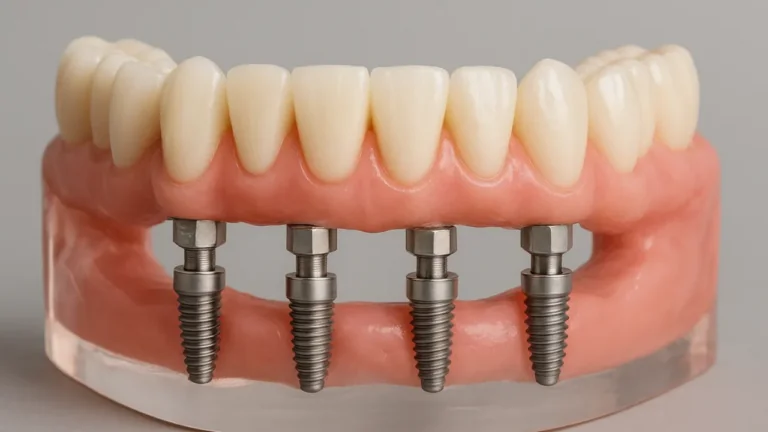
Where implants are involved, the itemisation matters most. A full-arch quote has around eleven lines, and the two most commonly missing — multi-unit abutments and the temporary bridge — are both substantial and both non-optional.
Currency, Fees and What They Actually Cost
Small percentages on large amounts are real money, and there are three places they accumulate.
The exchange rate itself. Your bank's rate, your card's rate and the terminal's rate all differ. Where a terminal offers to charge you in your home currency, declining and paying in the local currency is almost always better.
Transfer fees at both ends. International bank transfers frequently carry a sending fee and a receiving fee, and intermediary banks sometimes take a third. For a large payment it is worth asking who bears which.
Card fees. Some cards charge a foreign transaction fee on top of the exchange rate. It is usually a small percentage and it is worth knowing before rather than after.
None of these are anyone's fault and all of them are manageable by asking in advance. What is worth noticing is a clinic adding a surcharge for card payment specifically — that is a way of steering you towards a method with no record.
Insurance and What It Does Not Cover
Worth being clear about, because the two things people conflate here protect against entirely different risks.
Travel insurance covers the trip — cancellation, medical emergencies, lost luggage. Many policies exclude planned medical treatment abroad specifically, and complications arising from it. Read that clause rather than assuming.
Domestic dental insurance rarely covers treatment abroad, and where it contributes it usually requires pre-authorisation and specific documentation. Ask your insurer before travelling rather than submitting afterwards and hoping.
The treatment guarantee is not insurance and does not substitute for it. It covers materials and workmanship on the treatment provided; it does not cover a cancelled flight or an unrelated medical problem.
What is worth checking specifically is whether a policy covers a changed return flight if a complication delays you. That is the scenario where insurance actually helps in dental tourism, and it is the clause least often read — the guarantee covers a different set of things entirely.
If Something Goes Wrong With the Treatment
Payment structure matters here more than anywhere else, and this is why the staging principle is not academic.
Where payment has been staged and a problem emerges partway through, both sides have an interest in resolving it. Where the full amount was paid on day one, one side has already received everything it was going to receive.
The guarantee is what governs problems after completion, and its terms and its length both matter — ours runs for life, in writing. What it covers, what voids it, how a claim is made from another country, and who pays for travel if you need to return — all of that should be in writing before treatment.
Keep everything: the plan, the itemised quote, receipts for every payment, the guarantee document, the material records and the radiographs. That file is what any subsequent conversation runs on, whether with the clinic or with anyone else.
Most problems are small and resolved in a message with a photograph. The documentation matters for the small proportion that are not, and it costs nothing to have — what to send and when sets out the practical side.
Third-Party Agencies and Who Holds Your Money
Many international patients reach a clinic through an intermediary, and that arrangement changes where the money sits and who is accountable for what.
Some agencies are straightforward introducers paid a commission by the clinic, with the patient paying the clinic directly. That arrangement is transparent once you know it exists, and it does not change your relationship with the clinic.
Others collect payment themselves and pass a portion to the clinic. That inserts a party between you and the people treating you, and it means a dispute about treatment may involve someone who did not provide it.
The question worth asking directly is: who am I paying, and who is responsible if something goes wrong? Both answers should be a single named entity, and they should be the same one.
It also affects the plan itself. An intermediary paid by volume has an interest in larger treatments, and that interest is not aligned with yours. We deal directly with patients rather than through agencies, which is also why transfers and accommodation are arranged by us rather than resold.
The same question applies to the guarantee. If an agency collected the money, ask who the guarantee is with and who honours it — the terms should name the clinic that did the work, not a company that arranged the trip.
Questions to Settle Before You Travel
All of these are answerable in a single message by a clinic that has thought about them, and the answers should be in writing.
- Is anything due before the written plan exists?
- What are the payment stages, and what does each cover?
- Which payment methods are accepted, and is there a surcharge on any of them?
- In which currency is the figure fixed?
- What happens to the figure if the plan changes after examination?
- Will I receive an itemised receipt for each payment?
- Who exactly am I paying — the clinic or an intermediary?
- What does the guarantee cover, and who pays travel for a return visit under it?
The last question is the one most often unanswered and it deserves a specific reply. A guarantee that covers the work but not the journey is still a guarantee, and knowing which you have is better than assuming.
The fifth is the one that prevents the most common problem. A clinic that answers it clearly is committing to something; one that answers vaguely has left itself room.
Ask them at the consultation stage rather than at the point of payment. What that conversation should cover includes all of this alongside the clinical questions, and settling both together is considerably easier than raising money separately afterwards.
How Payment Works at Bağcılar
Nothing is due until there is a written plan you have agreed. That plan follows the examination and imaging, lists every tooth with its material and its reason, and comes with an itemised figure rather than a total.
Payment is staged against the treatment stages, and the schedule is set out before you travel so there is nothing to negotiate while you are in the chair. For treatment across two trips, the stages follow the trips.
Card and bank transfer are both accepted, and there is no surcharge for paying by card. Every payment is receipted and itemised against the plan. We do not require cash for any part of treatment.
You deal with us directly rather than through an agency, which means the person you paid and the people who treated you are the same, and a question about either goes to one place.
The figure does not change afterwards. Where something is found that alters the plan — uncommon once a CT has been read properly — it is discussed before the work is done, in writing, against the original plan, and the guarantee terms are given to you before treatment starts rather than afterwards.
The practical arrangements are worth setting out plainly, because vagueness here is where dental tourism most often goes wrong. Your plan and its figure are agreed in writing before you fly to İstanbul, not on arrival. Nothing is asked for up front beyond confirming the appointment. Payment is made at the clinic in Bağcılar as the treatment progresses rather than in advance, so what you pay is tied to what has actually been done. If the plan changes after examination — and occasionally it does, because radiographs show things photographs cannot — the change is discussed and re-agreed before any work proceeds, not added to an invoice afterwards.