

A Hollywood smile is a treatment plan, not a product on a shelf. What actually goes into the design, which problems have to be solved before it starts, and how the result is decided in advance.
"Hollywood smile" is a marketing term rather than a clinical one. It describes a result — an even, bright, well-proportioned front row — and not a specific procedure. What produces that result is different in almost every mouth.
That distinction matters, because it changes what you should be asking. The useful question is not "how much is a Hollywood smile" but "what does my particular case need in order to look like that, and what has to be dealt with first?"
What the Design Is Actually Based On
A smile that reads as natural follows a set of relationships, and a designed smile has to respect them or it looks obviously made.
- Midline. The line between the two central incisors should line up with the centre of the face, and its axis should be vertical. A midline that is off is noticed by everyone even when they cannot say why.
- Proportion. The central incisors are the widest and most dominant; laterals are narrower and slightly shorter; canines carry the corner. Making all six the same size is the single most common way a case ends up looking artificial.
- The smile line. The edges of the upper front teeth should follow the curve of the lower lip. A flat edge across all six teeth ages a smile and flattens the face.
- The gum line. Gum height should be symmetrical between matching teeth. This is often the real reason a smile looks uneven, rather than the teeth themselves.
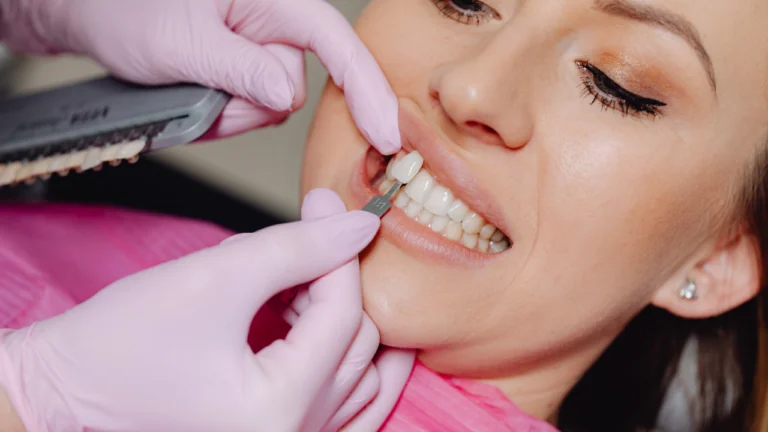
- Shade. A shade brighter than the whites of your eyes reads as false in photographs, whatever it looks like in the mirror.
Our smile design guide goes through each of these with examples.
Which Treatments Get Used
| Finding | Usual approach |
|---|---|
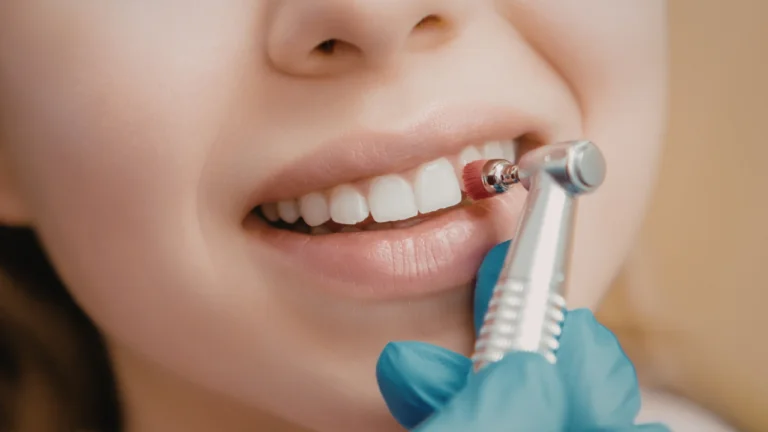
| Healthy teeth, colour and small shape changes wanted | Whitening, then bonding where needed |
| Shape and colour both need changing, teeth sound | Porcelain veneers |
| Teeth heavily filled, cracked or root treated | Crowns, because coverage is needed anyway |
| Gum showing too much when smiling | Gum contouring before restorations |
| Significant crowding or a bite problem | Aligners or braces first |
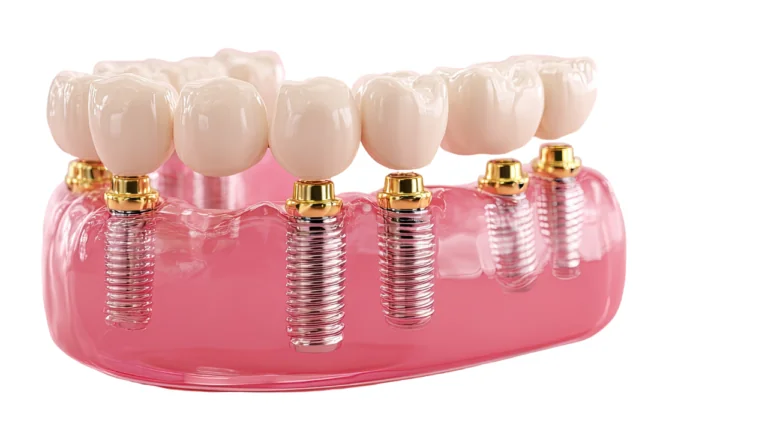
| Missing teeth in the smile zone | Implant or bridge before the aesthetic phase |
The bottom two rows are the ones most often skipped in a rush, and skipping them is what produces the results people later want redone. Restoring crowded teeth without moving them means grinding sound tooth structure away to fake alignment — the teeth end up straight-looking and permanently smaller. Moving them first, then restoring conservatively, keeps far more of the tooth.
The same logic applies to the gum line. If gum height is the asymmetry, no amount of work on the teeth corrects it; you end up with restorations of different lengths trying to compensate for gums that are at different heights.
Seeing the Result Before You Commit
The stage that changes how this treatment feels is the mock-up. Working from photographs, a facial scan and impressions, the proposed smile is designed digitally and then produced as a temporary version that goes directly onto your teeth, unprepared.
You then look at it in a mirror, in daylight, and speak with it in. You can photograph it. You can go away and come back. If the teeth are too long, too square, too bright or too uniform, that is the moment to say so — before anything irreversible has happened to a single tooth.
The mock-up also functions as the surgical guide. Once you approve the shape, preparation is done through it, which means only the amount of tooth structure the agreed design actually requires is removed — not a standard reduction applied to every tooth regardless.
How Long It Takes
- Examination, photographs and scan. Including x-rays, because underlying problems have to be found before a plan is drawn.
- Preliminary treatment. Fillings, gum treatment, root canals or extractions where needed. This phase has no fixed length; it depends on what is found.
- Design and mock-up. Approved by you before preparation.
- Preparation and temporaries. Teeth prepared through the guide, temporaries fitted the same day.
- Try-in and fitting. Final restorations checked in the mouth, adjusted, then cemented.
For a healthy mouth needing only the aesthetic phase, that sequence fits comfortably into a single visit to Istanbul of about a week, with a couple of days in the middle where you are free. Where preliminary treatment is needed — particularly implants or orthodontics — the plan is staged, and we tell you the real timeline at the examination rather than compressing it to sound convenient.
What It Does Not Fix
Restorations change teeth and gums. They do not change lip length, lip thickness, jaw position or facial asymmetry. A smile design works within your face and can flatter it considerably, but it is honest to say where its limits are.
Nor does it remove the need for maintenance. Restored teeth still decay at their margins, gums still recede if they are not looked after, and a person who grinds will still grind. A night guard, daily cleaning between the teeth and regular reviews are part of the plan, not optional extras added later.
Guarantee, and Why There Is No Price Here
Everything we place carries our lifetime guarantee, covering materials and workmanship alike. It comes from this clinic and it does not expire.
We do not publish figures. A smile design might mean whitening and two bonded teeth, or it might mean gum surgery, aligners and a full set of restorations. Quoting a single number for both would be misleading, and correcting it later is worse than never giving it.
The examination is free and includes the imaging. You will get a written plan, in stages, with the timeline for each. We are in Bagcilar, Istanbul, Monday to Saturday, 09:00 to 19:00.