













What Both Protocols Actually Are
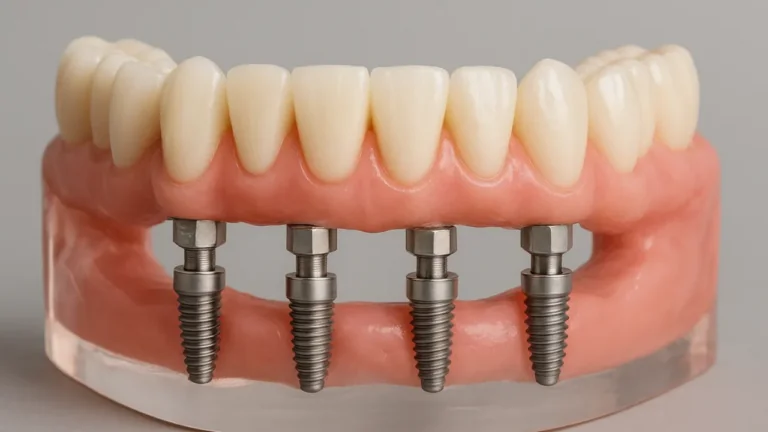
In both, a full arch of fixed teeth is supported by implants placed in the front and middle of the jaw, where bone is generally best preserved after tooth loss. A rigid bridge spans them and is screwed into place. Nothing is removable by the patient.
The rear implants in both configurations are usually placed at an angle rather than vertically. Tilting them lets the head of the implant emerge further back in the arch without entering the sinus above or the nerve canal below, which is the whole engineering insight behind these protocols.
That angling is what allows a full arch to be restored without grafting in cases that would otherwise need it, and it is why these protocols became standard for patients who had been told they had insufficient bone.
The difference between four and six is therefore not conceptual. It is a question of how many supports the bridge has and how much load each one carries — which is a structural question with a measurable answer.
What the Bone Decides — and Why Türkiye Quotes Four
A CT scan gives three numbers that matter: how much bone height there is, how much width, and how dense it is. Those determine what each implant can bear, and therefore how many are needed.
Dense bone provides high primary stability at placement, and implants in it can carry more load. Softer bone — which is common in the upper jaw, particularly towards the back — provides less, and compensating means either more implants or a longer healing period before loading.
Height and width determine what can be placed at all. Where there is enough bone in the front and middle but little at the back, angled placement solves it. Where there is little anywhere, grafting or a different protocol is needed first.
This is why any proposal made before a CT scan is a guess. The number of implants is the largest single variable in the plan, and it is determined by measurements nobody can make from a photograph.
Upper and Lower Jaws Are Different Problems
The two arches behave differently enough that the same patient can reasonably receive four implants in one and six in the other, and a plan proposing identical treatment for both has probably not distinguished them.
The lower jaw has denser bone, particularly at the front where the symphysis provides excellent anchorage. Four implants in a healthy lower jaw is a well-documented and predictable configuration.
The upper jaw is softer, and it has the sinuses above the back teeth reducing available height. Both factors argue for more support, which is why six is proposed more often in the upper arch than the lower — and why sinus procedures enter the discussion there and not below.
Where the upper jaw has lost a great deal of bone, zygomatic implants anchored in the cheekbone become the alternative to extensive grafting. That is a specialist procedure with a narrower set of indications.
The opposing arch matters as well. A full upper bridge biting against natural lower teeth is loaded differently from one biting against another bridge, and heavier than one opposing a denture. That comparison is part of the count decision rather than an afterthought.
Four Implants and Six Compared, Line by Line
The table sets out the practical differences. None of them makes one protocol better in the abstract — they describe which situations each suits.
| Four implants | Six implants | |
|---|---|---|
| Load per implant | Higher | Lower, spread across more supports |
| Bone required | Less — designed for limited volume | More, in more positions |
| Grafting | Often avoidable | More often needed in the upper jaw |
| If one implant fails | The bridge is usually compromised | Often salvageable on the remaining five |
| Bridge span | Longer unsupported sections | Shorter spans between supports |
| Suits heavy bite or grinding | Less well | Better |
| Surgical time | Shorter | Longer |
| Cost | Lower — fewer fixtures and components | Higher |
| Documented history | Extensive, over two decades | Extensive |
The failure row is the honest core of the comparison. Both configurations succeed at high rates, but the consequence of a single failure differs substantially between them.
One row deliberately absent is appearance. Both configurations carry the same bridge design, made by the same technician from the same materials, so the finished teeth look identical. Nothing about the implant count is visible once the restoration is in place.
When Four Is Genuinely Enough
In a lower jaw with reasonable bone density and volume in the front and middle, four implants is a well-evidenced configuration with long documented follow-up. It is not a compromise; it is the appropriate treatment.
It also suits patients where surgical time needs to be limited, where bone volume genuinely does not permit more without grafting, and where the alternative would be adding months of healing to a plan for marginal benefit.
There is a further argument that is rarely made and is real: every additional implant is an additional surgical site, an additional healing site, and an additional thing that can develop problems around it. More is not automatically safer.
What four does require is a well-designed bridge and a bite that has been properly assessed. Where those are right, the configuration performs — and how the treatment actually runs sets out the sequence in full.
The evidence base matters here too. Four-implant full-arch treatment has been documented over two decades with large published series and long follow-up, which is considerably more than can be said for several protocols marketed as improvements on it.
When Six Is the Better Answer
Six earns its place where load is high or bone is soft, and the two frequently occur together. The upper jaw is the common case, particularly where the patient also has a strong bite or a grinding habit.
Grinding is the most underweighted factor in this decision. Someone who clenches at night applies force to a fixed bridge for hours, and spreading that across six supports rather than four is a meaningful structural difference. Managing the habit is part of the plan either way.
Redundancy is the second argument. If one of six implants fails, the bridge can frequently be maintained on the remaining five while the site is dealt with. With four, losing one usually means the entire restoration has to be revisited.
Six also permits a bridge with shorter unsupported spans, which reduces flexing under load. For a long arch in soft bone, that is the difference between a restoration that is stable and one that is merely adequate.
Why More Implants Is Not Automatically Better
The instinct is that six must be safer than four, and eight safer than six. It is not that simple, and the reasoning is worth understanding because it is the part patients are rarely given.
Placing implants where bone is poor to reach a target number creates weak supports rather than strong ones, and a failing implant next to a healthy one can compromise both. An implant placed for the sake of the count is a liability, not an insurance policy.
Additional fixtures in an arch also make the bridge harder to fit passively. A bridge that does not seat without strain on every support puts continuous load into the implants, and precision becomes harder as the number rises.
So the correct number is the number the bone supports well, which is why this cannot be decided from a preference. Where a clinic offers a choice between protocols by price rather than by scan, the choice being offered is commercial.
The Bridge Material Matters as Much as the Count
A great deal of attention goes to the number of implants and comparatively little to what is screwed onto them, even though the bridge is what you actually live with and what most often needs attention.
Acrylic on a metal frame is lighter and repairable, and it absorbs some shock, but the teeth wear and stain over years. Monolithic zirconia is far harder, does not stain and does not wear, but it transmits load rather than absorbing it and is harder to repair if damaged.
The choice interacts with the implant count. A rigid zirconia bridge on four implants in soft bone concentrates force at the supports; the same bridge on six distributes it. This is one of the places where the two decisions cannot be made separately.
Ask which material is planned and why, alongside the implant count. How zirconia types differ covers the material properties that drive the decision.
The Timetable for Each
Both protocols commonly involve immediate provisionalisation: implants are placed and a temporary fixed bridge is fitted within a day or two, so you are not without teeth. That is a defining feature of these treatments and it applies to both.
The permanent bridge comes later, after integration — typically three to six months. That interval is not a scheduling choice, and any plan that promises the final restoration inside a single short trip is describing something biology does not permit.
Whether immediate loading is appropriate at all depends on stability measured at surgery, not on the protocol chosen. The criteria for loading early are the same whether four or six implants were placed.
Six adds modestly to surgical time and little to the overall timetable. Where a plan involving six takes considerably longer, the reason is usually grafting rather than the implants — the realistic timetables set out both.
Plan the second trip when you plan the first. The permanent bridge appointment is shorter than the surgical visit but it still needs several days for fitting and adjustment, and leaving it unscheduled is how patients end up wearing a temporary far longer than intended.
Cost, and What the Difference Buys
Six implants cost more than four: two additional fixtures, two additional abutments, longer surgery. That difference is straightforward and it appears plainly in any itemised quote.
What it buys is redundancy and load distribution. Whether that is worth paying for depends entirely on your bone and your bite, which is the same answer as everywhere else on this page.
Where it is not worth paying for — a dense lower jaw, a moderate bite, adequate volume in the front and middle — four is the correct treatment and six is simply a larger bill. Where it is worth paying for, saving on it is a false economy of a serious kind.
How the whole arch is quoted, line by line, is set out in the full-arch cost breakdown, including the components that incomplete quotes tend to leave out.
Compare the whole restoration rather than the per-implant figure. A quote with six implants and an acrylic bridge and one with four and a zirconia bridge are not comparable at all, and the bridge is frequently the larger line of the two.
When Neither Is the Right Answer
Both protocols assume a full arch is being replaced. Where some healthy teeth remain, removing them to fit a full-arch bridge is a decision that deserves far more scrutiny than it usually receives.
Extracting sound or restorable teeth to simplify a treatment plan is not a clinical decision, and it is irreversible in the most complete sense available in dentistry. Individual implants and conventional bridgework can restore a partially dentate arch without that step — the options for partial tooth loss set them out.
Severe bone loss can also put both protocols out of reach without preparatory work. Grafting, sinus procedures or zygomatic implants become the conversation, and that is a longer treatment rather than a different marketing name.
Where implants are genuinely not possible or not wanted, a well-made implant-retained overdenture is a legitimate answer rather than a lesser one — the comparison covers what each actually delivers.
Age and general health belong in this conversation as well. A long surgical session under local anaesthetic is demanding, and for a frail patient a staged approach, or a well-retained overdenture on two implants, can deliver more of what actually matters than a full fixed arch does. The best plan is the one the patient can complete and maintain.
What to Ask Before Agreeing
Five questions, all answerable from the CT scan and the examination. If the answers are not available, the plan is not ready.
- What did the CT show about bone height, width and density in each arch?
- How many implants are proposed in each arch, and why that number?
- Are any being placed at an angle, and where will they emerge?
- What material is the bridge, and how does that interact with the implant count?
- If one implant fails in five years, what happens to the restoration?
The last question separates the protocols more sharply than anything else, and it is rarely volunteered. A clinic that has planned for it answers specifically.
Ask them at the consultation, while the plan is still being written. What else a consultation should cover sets out where these fit alongside the rest.
Ask also what the maintenance schedule looks like. A full-arch bridge is cleaned underneath daily and is usually unscrewed and professionally cleaned at intervals, and knowing that in advance is part of deciding whether the treatment fits your life.
How Many Implants We Recommend, and Why
From the CT scan, arch by arch. Bone height, width and density are measured in each region, and the number of implants follows from what those measurements will support — which frequently means a different number in the upper jaw than in the lower.
Your bite is assessed as part of it. A heavy bite or a grinding habit changes the load a bridge will carry for years, and it feeds into both the implant count and the bridge material rather than being noted and set aside.
We will not extract sound or restorable teeth to make a full-arch plan simpler. Where part of the arch can be saved, the plan says so, even when that produces a more complicated treatment than a full clearance would.
The plan is written with the implant positions, the system, the bridge material and the sequence, and everything placed carries a lifetime guarantee on materials and workmanship, in writing — with the exclusions stated plainly.
There is a Turkish dimension to this choice that is rarely stated. Four implants became the headline number in dental tourism because it is the cheapest full-arch offer that can be advertised, and a clinic quoting a package has a commercial reason to prefer it regardless of the jaw in front of it. That does not make four implants wrong — in the right bone, with the right prosthetic design, it is a well-evidenced protocol. It makes the reasoning worth asking about. In Bağcılar the number comes out of the CBCT and the opposing bite rather than out of a price list, and where six is the right answer the plan says six before you book rather than after you arrive.