










What It Actually Is
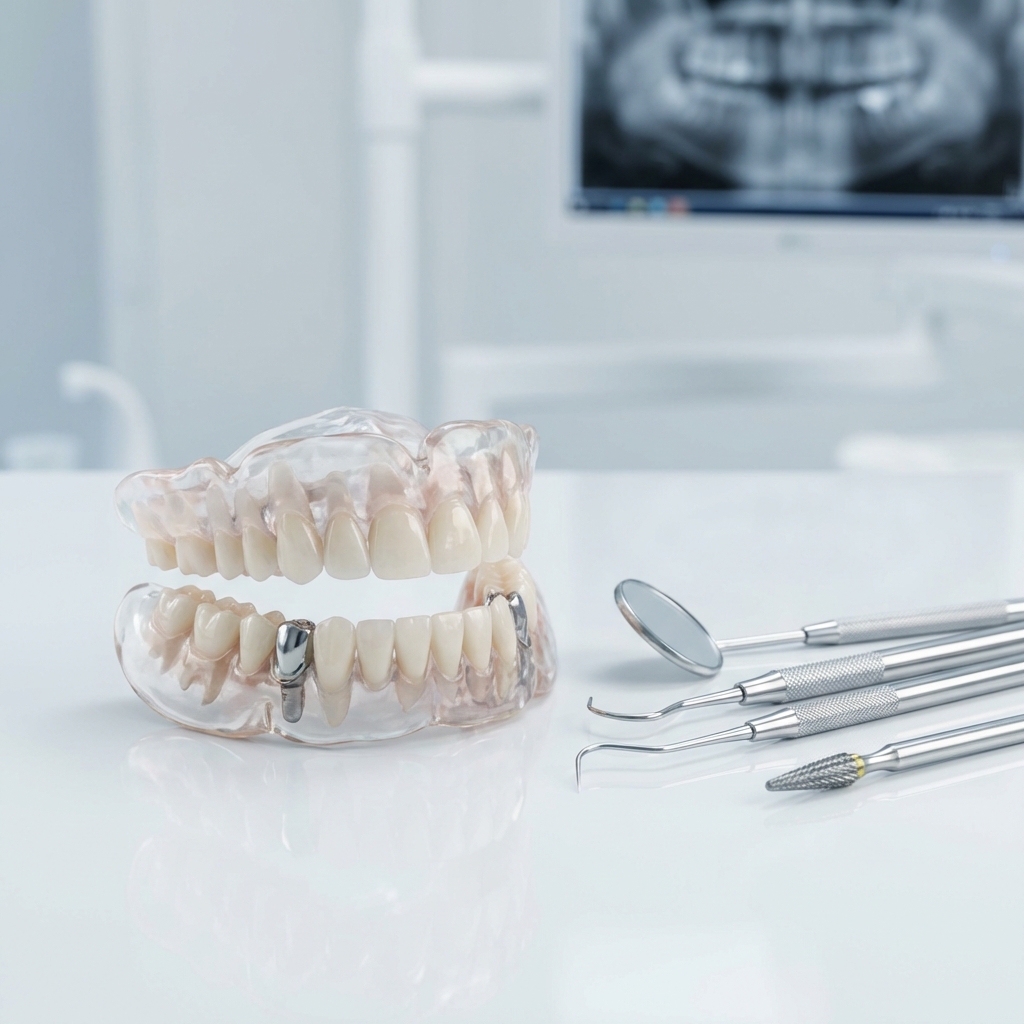
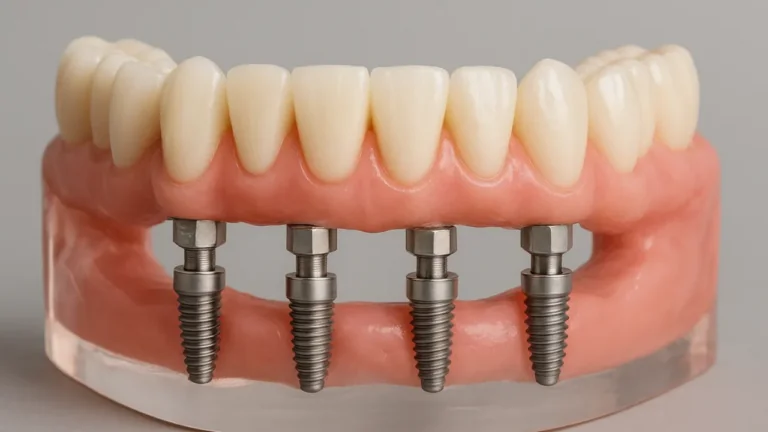
Implants are placed in the jaw and left to integrate. An attachment is fitted to each, and matching housings are built into the fitting surface of the denture. The denture clicks onto them.
You take it out to clean it and, usually, at night. It sits on the gum as a denture does and derives some support from the ridge. What the implants provide is retention — they stop it lifting and sliding.
That distinction matters for expectations. It is not a fixed bridge and it does not feel like natural teeth. It is a denture that stays where it is put, which is a considerably lower bar and the one most patients are actually asking for.
Chewing improves substantially because you can apply force without the denture moving. Speech improves because the tongue is no longer holding it. And the confidence effect is disproportionate to the size of the treatment.
It is a middle option in every sense — between removable and fixed, between minimal and extensive surgery, and between the two ends of the cost range in the wider comparison.
It also preserves bone where the implants sit, which a conventional denture does not. The resorption that continues under a plain denture is slowed in the front of the jaw, and that is part of why the fit holds longer.
How Many Implants
The answer differs between the arches and it is one of the few places where the lower jaw is the easier problem.
Two implants in the lower jaw is the established minimum and it is genuinely sufficient for most patients. They are placed in the front where bone is densest, and they transform retention.
Four in the lower jaw adds stability and allows a bar connecting them, which distributes load and reduces rocking further. It is worth having where bone permits and where the patient's bite is heavy.
The upper jaw generally needs four rather than two. Bone is softer, and an upper overdenture on two implants tends to rock. Four allows the palate to be opened up, which restores taste and is frequently the reason patients want it.
That palatal coverage point is the strongest argument for the upper version. A conventional upper denture dulls taste substantially, and removing the palate is only possible when implants provide the retention it was giving.
The Attachment Systems
Five in common use. They differ in retention strength, in maintenance and in how much space they need under the denture.
| System | How it works | Suits | Maintenance |
|---|---|---|---|
| Ball attachments | A stud on each implant, a housing in the denture | Two-implant lower cases | Inserts replaced periodically |
| Locator-type attachments | Low-profile stud, replaceable nylon insert | Most cases; needs little vertical space | Inserts replaced periodically |
| Bar attachment | Implants joined by a bar, denture clips over it | Four implants, heavier bites | Clips replaced; bar cleaned underneath |
| Magnetic attachments | Magnets in denture and implant | Limited use; easy to place and remove | Lower retention; corrosion over time |
| Telescopic crowns | Precision-fit inner and outer copings | Selected cases with natural teeth remaining | Higher cost; excellent stability |
Locator-type attachments are the most widely used because they combine good retention with a low profile and easily replaceable inserts. The inserts come in different strengths, so retention can be adjusted without changing anything surgical.
A bar costs more and distributes load better. Where four implants are placed and the bite is heavy, it is frequently the better engineering — but it needs more space and more cleaning underneath.
Why It Needs So Much Less Bone
The practical reason this option is available to patients who have been told a fixed arch is not possible.
A fixed bridge is carried entirely by its implants, which means implants distributed along the arch including at the back where bone is frequently short or the sinus is in the way.
An overdenture shares the load. The implants provide retention and the ridge still provides support, so the implants can be concentrated in the front where bone is best preserved after tooth loss.
That means no posterior implants, frequently no sinus lift, and often no grafting at all in a jaw where a fixed arch would have needed substantial preparation — the grafting that is avoided is a real saving in both cost and months.
It also means shorter surgery, which matters for older patients or anyone for whom a long session is difficult. Two implants in the lower front is a straightforward procedure.
Who It Suits Best
Five groups, and the first is by far the largest.
- Anyone with a lower complete denture that will not stay in place.
- Patients with insufficient bone for a fixed arch who do not want extensive grafting.
- Patients for whom a long surgical session is medically inadvisable.
- Patients who want the upper palate opened up to restore taste.
- Anyone for whom the cost of a fixed arch is out of reach but a denture is not working.
The first group is the one this treatment exists for. A patient who has had three lower dentures remade and still cannot eat comfortably does not need a fourth — the appliance is not the problem.
The fourth is under-appreciated. An upper denture covering the palate dulls taste and temperature noticeably, and patients frequently do not connect the two until it is removed.
The fifth is a genuine economic case rather than a compromise. Two implants and a clip-fit denture solve most of the functional complaint for a fraction of what a fixed arch involves.
A sixth group is worth naming: patients whose bone has already resorbed substantially because a denture has been worn for many years. Grafting for a fixed arch in that situation is extensive, and an overdenture frequently avoids the whole question.
Where a Fixed Bridge Is the Better Answer
Honesty in the other direction, because an overdenture is not always the right middle ground.
Where a patient dislikes the idea of anything removable, that is a legitimate preference rather than a misunderstanding to correct. An overdenture comes out, and for some people that is the whole objection.
Where the ridge is very flat, an overdenture has little support from the tissue and relies more heavily on the attachments, which wears them faster and can produce a less stable result than expected.
Where the patient has good bone volume and can tolerate the surgery, a fixed arch delivers chewing function closer to natural teeth and does not have to be taken out — how the implant count is decided for that route comes from a CT scan.
And where manual dexterity is limited, clipping a denture on and off repeatedly can be genuinely difficult. That is worth assessing rather than assuming, and it occasionally points towards fixed.
The Maintenance Nobody Mentions
Real, predictable and inexpensive, and it should be explained before treatment rather than encountered as a surprise.
The attachment inserts wear. Nylon inserts in locator-type attachments are consumable by design and are replaced periodically — a short appointment, and retention returns to new.
The denture itself still needs relining as the ridge changes, though more slowly than a conventional one because the implants preserve bone in the front where they sit.
Cleaning is more involved. The implants and attachments have to be cleaned around daily as well as the denture being cleaned out of the mouth, and gum inflammation around an implant is what ends it.
None of that is onerous. It is the price of the retention, and it compares favourably against the reline-and-remake cycle of a conventional denture on a resorbing ridge.
Cleaning around the implants is the part that matters most. Inflammation around a fixture causes bone loss and it is the main way implant-retained cases fail — the denture is rarely the problem.
The Treatment Sequence
Two visits for a patient travelling, with the integration period between them, and you are never without a denture at any point.
First visit: assessment with a CT scan, implant placement in the front of the jaw, and your existing denture is hollowed over the healing sites and soft-lined — it is left out for the first days while the tissue closes, and worn normally after that.
Integration takes three to six months, during which nothing is required of you beyond normal denture wear and hygiene. That interval is biological and cannot be compressed.
Second visit: attachments fitted to the implants, housings processed into your denture or a new denture made to fit them, and retention adjusted to a comfortable level.
Whether your existing denture can be converted or a new one is needed depends on its condition and fit. An old, worn denture is usually worth remaking, and that is established at the first visit rather than at the second.
The assessment at the first visit covers more than the bone. Gum health, any remaining teeth, the existing denture and your bite all feed into the plan, and the full examination is what establishes whether two implants or four are appropriate.
Converting an Existing Denture
Frequently possible and worth asking about, because it changes both the cost and what you wear during treatment.
Where a denture fits reasonably, has acceptable tooth position and enough thickness in the fitting surface, the housings can be processed into it directly. That saves making a new appliance entirely.
Where it is thin, worn, badly fitting or the teeth are set poorly, converting it produces a poor result on a good foundation. A new denture made to the implants is the better answer and it is worth the difference.
The assessment is straightforward and happens at the first visit: fit, thickness, tooth position, bite and condition. It is not a judgement call so much as a set of measurements.
Where a new denture is made, it goes through the same stages as any well-made one — the working impression, bite registration and try-in matter as much here as anywhere.
What It Feels Like
Worth describing because the expectation-setting determines satisfaction more than the treatment does.
It clicks in and out with a definite action. Most patients learn it within a day and it becomes automatic. There is a knack to seating it evenly rather than at an angle, and it is taught at the fitting.
Eating changes immediately and noticeably. The denture does not lift when you bite, which means you can use the front teeth and apply real force at the back — both of which a conventional lower denture rules out.
It still covers tissue and it is still removable, so it does not feel like natural teeth. Patients who expected that are disappointed; patients who expected a denture that stays put are usually delighted.
The upper version with the palate opened up produces a second effect people do not anticipate: food tastes of something again, and that is frequently the change mentioned first.
Cost, Relative to the Alternatives
Without figures, the relative positions are clear enough to be useful and they are the reason this option deserves raising.
Considerably more than a conventional denture, because it involves implant surgery, components and attachments. That is a real difference and it is the reason it is not the default.
Considerably less than a fixed full arch, because it uses two to four implants rather than four to eight, needs no posterior implants, frequently avoids grafting and uses a denture rather than a milled bridge.
Over time it compares well against the conventional denture route, because the implants preserve bone in the front and slow the reline-and-remake cycle that drives the long-term cost of a plain denture.
For a patient who has already remade a lower denture more than once, the arithmetic frequently favours it outright — the reline and remake cycle is what makes that comparison work.
It also compares differently against a fixed arch depending on the jaw. In the lower jaw the gap is largest, because a fixed arch there needs considerably more implants than an overdenture does — where the fixed counts sit sets out the alternative.
Questions Worth Asking
Six, all answerable from the scan and the examination, and the answers should be in the written plan.
- How many implants, in which positions, and why that number?
- Which attachment system, and why that one?
- Can my existing denture be converted, or is a new one needed?
- Will the upper palate be opened up, if this is an upper case?
- How often will the attachment inserts need replacing?
- What happens to the retention as the ridge changes underneath?
The third is the one that changes the figure most, and it is a measurable assessment rather than an opinion. Ask what specifically about your current denture makes it convertible or not.
The fifth establishes the maintenance expectation before treatment rather than afterwards. Inserts are consumable by design, and knowing that in advance stops it feeling like a fault.
Ask also what happens if you later want to convert to a fixed arch. In some cases the existing implants can be incorporated and in others they cannot, and knowing that in advance keeps the decision open rather than closing it quietly.
Having Implant-Retained Dentures Fitted in Türkiye
This is the option most patients arriving in İstanbul have never been offered, and it sits precisely between the two they were: a conventional denture they do not want, and a full fixed bridge on six or eight implants. Two to four implants and a denture that clips onto them solves the complaint people actually have — a lower denture that moves — for a fraction of the surgery, which is why we raise it even when somebody arrived asking about All-on-4.
The travel logistics suit it well. The implants go in at the first visit, and your existing denture is hollowed over the healing sites and soft-lined, so you leave with something to wear. The attachments are connected at the second visit once integration is complete, three to six months later, and the denture is either relined onto them or remade. Two short trips rather than one long one, and nothing about the interval between them requires you to be in Türkiye.
One point of honesty the sales version of this treatment usually leaves out: on the upper jaw, an overdenture on only two implants normally still needs palatal coverage for support. The palate is freed reliably only with four or more well-distributed implants. If being rid of the palate is what you want, that is a four-implant conversation, and it is far better had before the surgery than after. The full comparison between the routes sets out where each one stops.
Attachments are consumable by design — the retentive inserts wear and are replaced periodically, which is a maintenance item rather than a failure, and we say so in advance rather than at the first replacement. The implants and the prosthetic work themselves carry our lifetime guarantee on materials and workmanship, in writing.
How the Attachment System Is Chosen
By raising it, first of all. Any patient struggling with a lower denture is told about this option explicitly rather than being offered another remake.
The implant count and positions come from a CT scan — bone height, width and density in the front of the jaw determine what is possible, and the upper and lower arches are assessed separately because they behave differently.
Your existing denture is assessed for conversion at the first visit, with the measurements that decide it explained rather than asserted. Where it can be converted, that is what we propose.
The attachment system is chosen for your case and named in the plan, along with how often inserts will need replacing and what that involves.
You are never without a denture at any stage, and everything placed carries a lifetime guarantee on materials and workmanship — with attachment inserts identified as consumable rather than left ambiguous.
The maintenance schedule is set out in writing at the same time — how often inserts are replaced, what the cleaning routine is, and when the denture is likely to need relining.