












Why the System Is a Long-Term Decision
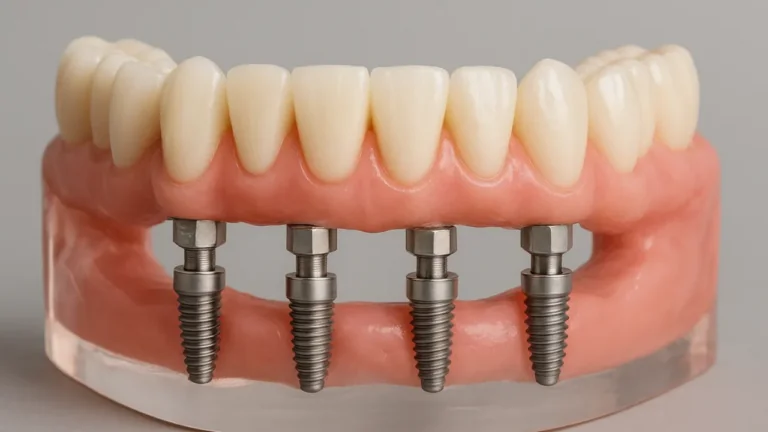
An implant is placed once and expected to last decades. Over that period the titanium in the bone is the part least likely to cause trouble. What causes trouble is everything that attaches to it — abutments, screws, and the crown — all of which are system-specific components.
A screw fractures. An abutment needs replacing after gum recession. A crown needs remaking. Each of those is a small routine job if the parts are available and an intractable problem if they are not.
That is the real question behind implant brands, and it is easy to lose sight of it in a discussion about surface coatings. Will a dentist in your own city, fifteen years from now, be able to order a component that fits?
Everything else on this page feeds into that. The evidence base, the manufacturer's stability, the distribution network and the connection design all determine whether your implant remains serviceable long after the clinic that placed it has stopped being part of your life.
What Actually Differs Between Systems
Five things, and only two of them are usually discussed in marketing. The material is not one of them: essentially all implants are commercially pure titanium or a titanium alloy, and the differences there are small.
- The connection between fixture and abutment — geometry, seal and stability.
- Manufacturing tolerance, which determines how precisely components seat.
- Surface treatment, which affects how quickly bone attaches.
- The volume and quality of published independent survival data.
- Distribution and the manufacturer's likely lifespan as a company.
The last two are not clinical properties at all, and they are arguably the most important. A technically excellent implant from a company that leaves the market is worse, in the long run, than a merely good one from a manufacturer that will still exist in twenty years.
Thread design, length and diameter also vary, but those are selections made for your anatomy within a system rather than differences between systems.
One further difference sits above the fixture entirely: how many restorative options a system supports. A well-supported system offers stock and custom abutments, angled options, and both screw-retained and cemented solutions, which gives the technician room to solve an awkward angle. The crown that sits on top is then a free choice rather than a constrained one.
Surface Technology and How Fast Bone Attaches
The implant surface is roughened at a microscopic scale so that bone can grow into it rather than merely against it. Every current system does this; the methods differ — sandblasting, acid etching, or a combination — and each manufacturer markets its own.
What surface treatment actually influences is speed. A well-engineered surface shortens the integration period somewhat and improves stability in softer bone. This matters most where bone quality is poor and where earlier loading is being considered.
What it does not do is rescue poor placement or compensate for insufficient bone. Surgical technique, primary stability at placement and bone volume determine success far more than surface chemistry does.
Treat surface marketing with mild scepticism. The differences between established systems are real but modest, and they are not where the gap between a premium and a budget implant mainly lies. Where earlier loading is appropriate is decided by measured stability, not by a coating name.
The Connection: Where Systems Genuinely Diverge
The joint between the fixture and the abutment is the most engineering-sensitive part of an implant, and it is where premium systems earn their reputation. It has to resist chewing forces for decades without loosening and without letting bacteria through.
Older external connections sat proud of the fixture and were more prone to screw loosening. Modern internal connections seat the abutment inside the implant, distributing force better. A conical or tapered internal connection goes further and creates a friction fit that behaves close to a single unit.
The seal matters as much as the strength. A microgap at that junction lets bacteria colonise the interior of the implant, and that contributes to inflammation and bone loss at the crest. Tighter manufacturing tolerances produce smaller gaps.
Platform switching — using an abutment narrower than the fixture — moves that junction inward, away from the bone, and there is good evidence it helps preserve crestal bone. Whether a system supports it is a more useful question than which surface it uses.
The Three Tiers, and What Separates Them
The market divides roughly into three groups. The table sets out what distinguishes them in terms that can be checked, rather than by reputation.
| Premium systems | Established mid-range | Budget systems | |
|---|---|---|---|
| Published data | Three to four decades, large independent studies | One to two decades, reasonable independent data | Little independent literature |
| Distribution | Global, in almost every country | Regional to international | Often limited to a few markets |
| Parts in 15 years | Very likely obtainable anywhere | Likely obtainable | Uncertain |
| Connection | Conical internal, platform switching | Internal, often conical | Varies widely |
| Manufacturing tolerance | Tightest, smallest microgap | Good | Variable batch to batch |
| Company longevity | Decades of trading history | Established | Frequently newer or smaller |
| Cost impact on quote | Largest single line | Moderate | Lowest — and it shows here first |
The important caveat: in the first five years, success rates across all three tiers are much closer than the table suggests. The tiers describe risk over decades, not whether the implant will integrate.
What Published Survival Data Actually Means
Manufacturers quote survival rates well above ninety-five per cent at ten years, and those figures are broadly accurate. They are also less informative than they appear, because 'survival' means the implant is still in the bone.
An implant can survive while the bone around it recedes, the gum inflames and the crown has been remade twice. 'Success', properly defined, requires stable bone levels and healthy tissue as well as retention, and success rates are always lower than survival rates.
The other thing to read is who conducted the study. Independent university research with long follow-up and clear drop-out reporting is worth far more than manufacturer-sponsored series. The premium systems' real advantage is the volume of the former.
None of this changes what happens to you individually. Your outcome is determined by your bone, your gum health, whether you smoke and how well the implant was placed — considerably more than by which of two documented systems was used.
Parts Availability a Decade From Now
This is the practical heart of the matter and the reason to care about brands at all. Implant components are proprietary: an abutment from one manufacturer does not fit another's fixture, and there is no universal standard.
So if a screw fractures in fifteen years, the dentist treating you needs to identify the system and order the exact part. With a globally distributed system that is a routine order. With an obscure one it may mean an implant that is perfectly healthy in the bone and cannot be restored above it.
The failure mode is worth stating plainly, because it sounds abstract until it happens: the only remaining option is removing an osseointegrated implant surgically and starting again, with bone grafting, on a patient fifteen years older than when they started.
That is the risk you are pricing when you choose a system. It is also why the question 'which brand' deserves an answer in writing before surgery rather than a reassurance afterwards — as the breakdown of an implant quote sets out line by line.
The Implant Passport
Every implant fixture arrives with adhesive labels recording the manufacturer, the product reference, the diameter and length, and the lot number. Those labels belong in your records, and you should leave with a copy.
This document is what makes your implant serviceable anywhere in the world. Any dentist can read it and order the correct component. Without it, identifying an unknown implant means guessing from a radiograph, which is possible for common systems and unreliable for the rest.
It is also the only way to verify that what was placed is what was quoted. A clinic that names a premium system and hands you a passport for it has demonstrated the claim rather than made it.
Ask for it at the time of surgery, not later. It should be offered without being requested, alongside your radiographs and the written guarantee — the wider set of records worth insisting on covers what else to take home.
Premium or Mid-Range: When the Difference Is Worth Paying
For a straightforward single implant in good bone in a healthy patient, an established mid-range system will almost certainly serve you as well as a premium one. The evidence for that is reasonable and the price difference is real money.
The case for premium strengthens where the situation is demanding. Poor bone quality, immediate placement into a fresh extraction socket, immediate loading, grafted sites, front teeth where the emergence profile is critical, or a patient who smokes or has a history of gum disease.
It also strengthens with the scale of the restoration. A full-arch reconstruction depends on every fixture and every component behaving predictably for decades, and the consequences of a discontinued part are proportionally larger.
For a younger patient the horizon argues the same way. Someone treated in their thirties needs the parts to exist for fifty years, not fifteen, and that is an argument about the manufacturer as much as about the implant.
Budget Systems and the Real Risk
The honest position is that inexpensive implants are not dangerous. They are regulated products, they integrate with bone, and in the early years they perform close to everything else on the market.
The risk is not clinical failure but orphaning. A system with limited distribution, from a smaller manufacturer, may simply not be supportable in fifteen years — either because the company has gone or because nobody in your country stocks the components.
There is a second, subtler issue. Where a very low quote is built on a budget system, the system is rarely the only economy. Surgical time, the ceramic, the abutment type and the completeness of the plan tend to move together.
If a budget system is what is proposed, ask three things: the manufacturer's name, how long it has been trading, and whether components are distributed in your own country. Reasonable answers make it a reasonable choice.
Scale changes the calculation. For a single tooth, an orphaned implant is a contained problem — it can be removed and replaced, or the space restored another way, as the alternatives set out. For a full-arch reconstruction it is not contained at all: every fixture carries part of one restoration, and a discontinued component affects the whole thing.
Does the System Change the Success Rate?
Less than almost anyone expects. Across documented systems, early integration rates sit within a narrow band, and the variables that move the outcome are overwhelmingly about the patient and the surgeon.
Smoking, uncontrolled diabetes, untreated gum disease, insufficient bone and poor placement technique account for the overwhelming majority of failures. Systems account for a small fraction of them, and mostly at the margins where conditions are already difficult.
This is why choosing a clinic matters more than choosing a brand. A premium implant placed at the wrong angle in inadequate bone will fail; a mid-range one placed correctly in prepared bone will not.
The brand question is really a question about decades three and four, and about what happens when a component needs replacing. Both matter — they simply matter at different points, and the causes of failure make the distinction clear.
The variables you can actually influence are worth listing in order: not smoking during healing, controlled blood sugar where relevant, gum disease treated before placement, and adequate bone — built beforehand with grafting where it is short. After that comes what you do in the first weeks. Every one of those outweighs the choice between two documented systems.
What to Ask Before Surgery
Six questions, all answerable in a single message by a clinic that has already thought about them. The answers belong in writing rather than in a conversation.
- Which implant system and which manufacturer, by name?
- How long has that manufacturer been trading, and where is it distributed?
- Will I receive the implant passport with lot numbers at the time of surgery?
- Is the abutment stock or custom-milled, and is the crown screw-retained?
- If a component fails in fifteen years, how would a dentist in my country order it?
- Is the system the same one used for every patient here, or chosen per case?
The last one is more revealing than it looks. A clinic that uses a single system for everything is buying on price; a clinic that selects by case has a clinical reason for each choice and can explain it.
If any answer is vague, that is the answer. This is not specialist knowledge being requested — it is the information already on the box.
Ask them at the consultation rather than on the day of surgery, while the plan is still being written and changing it costs nothing. What a first consultation should cover sets out where these questions fit alongside everything else being decided.
Which Implant Systems Are Actually Used in Türkiye
The honest answer is: all of them. İstanbul's volume means every major system is available here, from the Swiss and Swedish manufacturers with thirty years of published data to systems that appeared five years ago and are sold on price. That is a genuine advantage, because the choice is not constrained by what a single distributor supplies — and it is also the reason the question of which system is in your quote matters more here than almost anywhere.
A quote that says implant without naming the system has left out the single most consequential detail. Not because cheaper systems fail more often in the first years — most modern implants integrate reliably — but because of what happens in year twelve, when a component needs replacing and the manufacturer no longer exists or never sold into your country. An implant whose parts cannot be sourced is a surgical problem rather than a prosthetic one.
What we place is named in your plan with the manufacturer, the diameter and the length, and it goes into an implant passport you take home along with the batch numbers. Any dentist anywhere can then order the right component without guessing. Asking any İstanbul clinic whether you will receive that document, and what will be written on it, is the most useful implant question there is.
The other Turkish-specific point worth knowing is that implantology is not a recognised speciality in Türkiye, which means the title implant specialist is not a protected qualification here. That is not a warning about the country — it is the same in several European systems. It simply means the credential to ask about is the individual's training and case volume rather than the word on the website. How to verify what you are told sets out exactly what to request.
Parts availability is the part of this that is genuinely country-specific, and it is worth checking before you choose rather than afterwards. Which systems are widely serviced in the UK, the United States and Canada is not the same list, and an implant passport is only useful if somebody near you can act on it.
How We Handle This at Bağcılar
The system planned for you is named in your written treatment plan, before anything is agreed, along with the abutment type and the crown material. It is not described as "a premium implant" or "a European system" — it is named, so that you can look it up.
The choice is made per case rather than by default. Bone volume and quality, the position in the arch, whether the site was grafted, whether you smoke and whether immediate loading is being considered all feed into it, and we explain the reasoning rather than asserting it.
You receive the implant passport at the time of surgery, with the manufacturer, reference and lot number of every fixture placed, alongside your radiographs and material records. Those documents are what make the work serviceable anywhere, by anyone.
Everything we place carries a lifetime guarantee on materials and workmanship, in writing, with the exclusions stated plainly — what is covered and what is not is set out in full rather than summarised.