












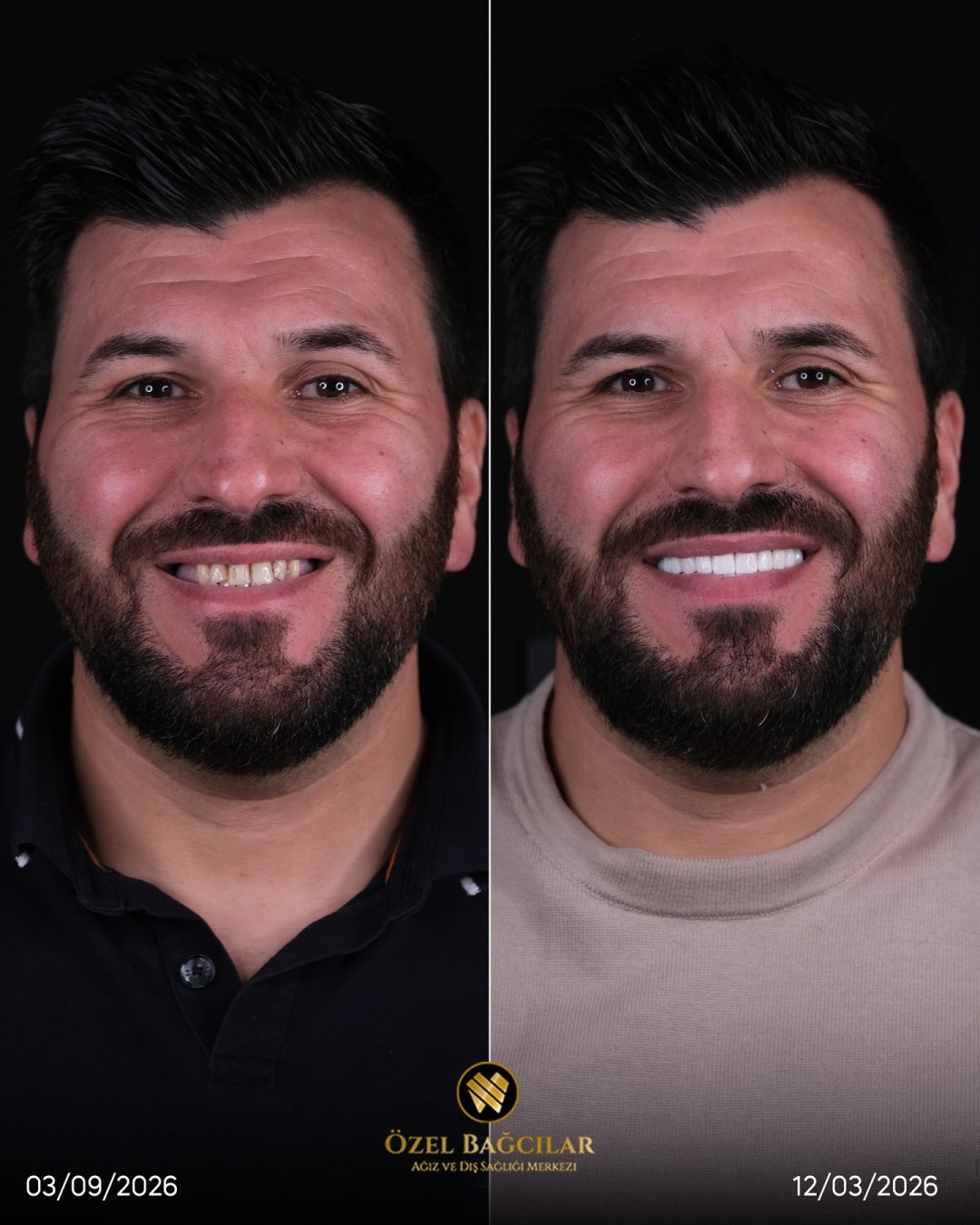
Why Gaps Form
The most common reason is simple arithmetic: the teeth are narrower than the jaw that holds them. Tooth size and jaw size are inherited separately, so a person can end up with small teeth in a wide arch. Nothing is wrong; there is just spare space, and it tends to collect at the midline.
The second common cause is the labial frenum — the small band of tissue running from the inside of the upper lip to the gum above the front teeth. In some people it attaches low, between the teeth rather than above them, and physically holds the gap open. This one matters because closing the space without addressing the frenum is the classic reason a gap reopens within a year.
Missing or undersized lateral incisors — the teeth either side of the two front ones — leave space that the central teeth drift into. So does the loss of any tooth further back, because the whole arch slowly shifts forward to fill it. That is why a gap at the front can be caused by a missing molar nobody has thought about for years.
Habits account for the rest. Prolonged thumb sucking in childhood, and in adults a persistent tongue thrust against the front teeth when swallowing, apply small forces thousands of times a day. Teeth move under sustained light force — that is the entire principle orthodontics works on — so the habit wins over time.
The Gap That Appears Later
A diastema that develops in adulthood deserves an explanation before it receives a treatment. In an adult mouth, teeth do not move without a reason.
The most serious cause is periodontal disease. As the bone supporting the teeth is lost, the teeth lose their anchorage and drift — typically flaring outwards and opening spaces at the front. This is often the first thing a patient notices, long after the disease has been progressing silently. Closing the gap cosmetically while the bone loss continues is treating the symptom and ignoring the illness. Gum disease and recession needs stabilising first.
Less alarming but equally real: the loss of a back tooth changes how force is distributed across the arch, and the front teeth take load they were not designed for. Over a few years they splay. Heavy clenching and grinding does something similar.
The practical rule is straightforward. If the gap has been there since your teens, treat it as cosmetic and choose whichever method you prefer. If it opened in the last five years, ask what changed — and expect a periodontal assessment before any cosmetic work is proposed. Where a back tooth has been lost, replacing it is often the treatment that stops the front teeth drifting further.
Option One — Composite Bonding
Tooth-coloured resin is added to the adjacent edges of both teeth, shaped by hand, hardened with a light and polished. The gap is filled by making the teeth slightly wider rather than by moving them. It is done in one appointment and usually requires no drilling at all.
For gaps up to roughly two millimetres it is an excellent solution — quick, reversible in the sense that no enamel is removed, and considerably less expensive than the alternatives. Because nothing is cut, a patient who dislikes the result can have the composite removed and be back where they started.
The limits are proportion and durability. Widening two central incisors to close a large gap makes them noticeably too wide for the face, and the result looks odd in a way patients struggle to articulate afterwards. Above about two millimetres, the material should be spread across four teeth rather than two, which changes the scope considerably.
Composite also stains at the margins over several years, particularly in coffee and tobacco users, and chips more readily than ceramic. It is maintainable — polishing and small repairs are straightforward — but it is not a fit-and-forget solution. The composite versus porcelain question is worth reading before deciding.
Option Two — Porcelain Veneers
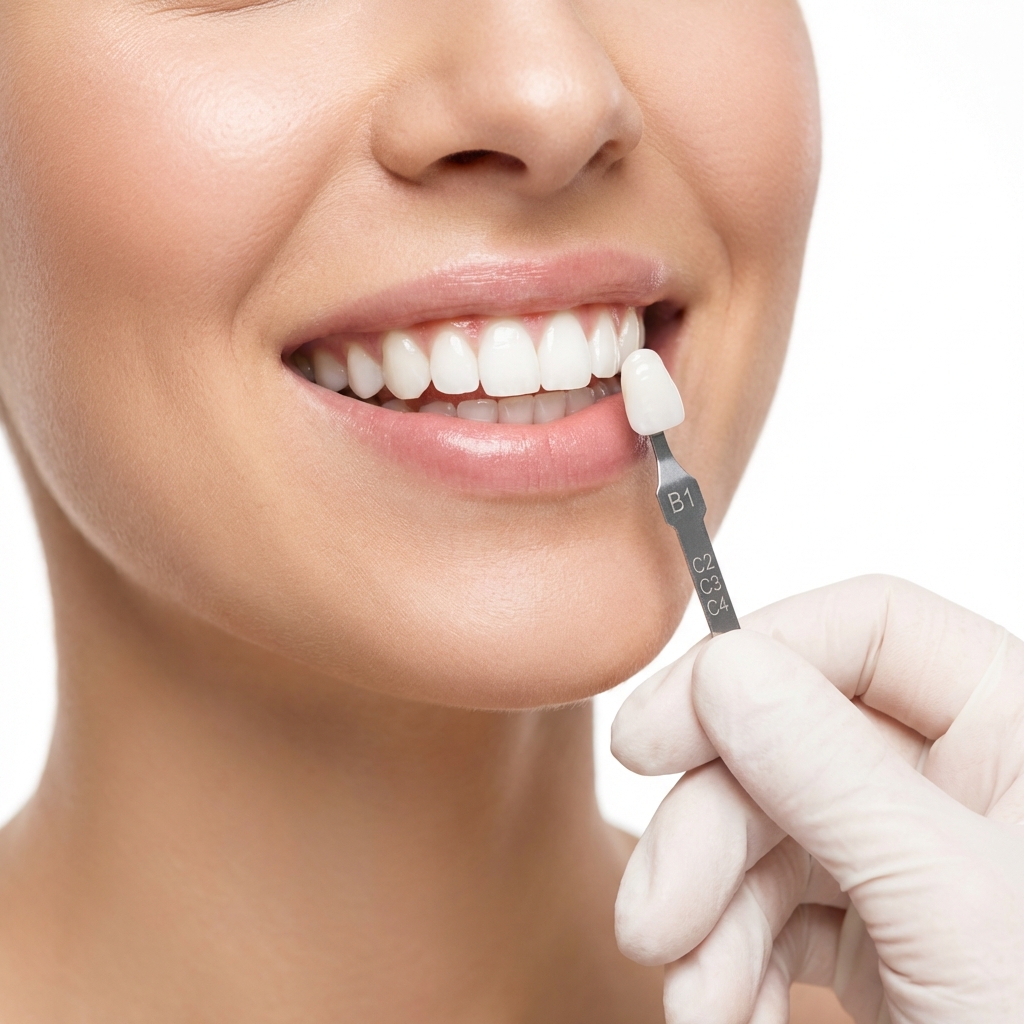
Thin ceramic shells are bonded to the front surfaces of the teeth, made slightly wider than the natural teeth to eliminate the space. Because they are made in a laboratory to a planned design, the control over shape, proportion and colour is considerably greater than with hand-shaped composite.
Veneers hold their colour far longer, resist chipping better and typically last many years with reasonable care. For a patient who also wants to change the shade or shape of the front teeth, closing the gap becomes almost a by-product of the wider result.
The cost is enamel. A layer is removed from the front of each tooth to make room for the ceramic, and that is permanent — the teeth will always need to be covered from then on. For a young patient with otherwise perfect teeth and a small gap, that is a disproportionate trade, and any dentist proposing veneers in that situation without discussing bonding first is not giving balanced advice.
Veneers also usually involve four teeth rather than two, because treating only the central incisors leaves a visible difference in surface and colour beside them. That is a design decision, not an upsell, and it should be explained before you agree to anything. Digital planning lets you see the proposed proportions before enamel is touched.
Option Three — Clear Aligners
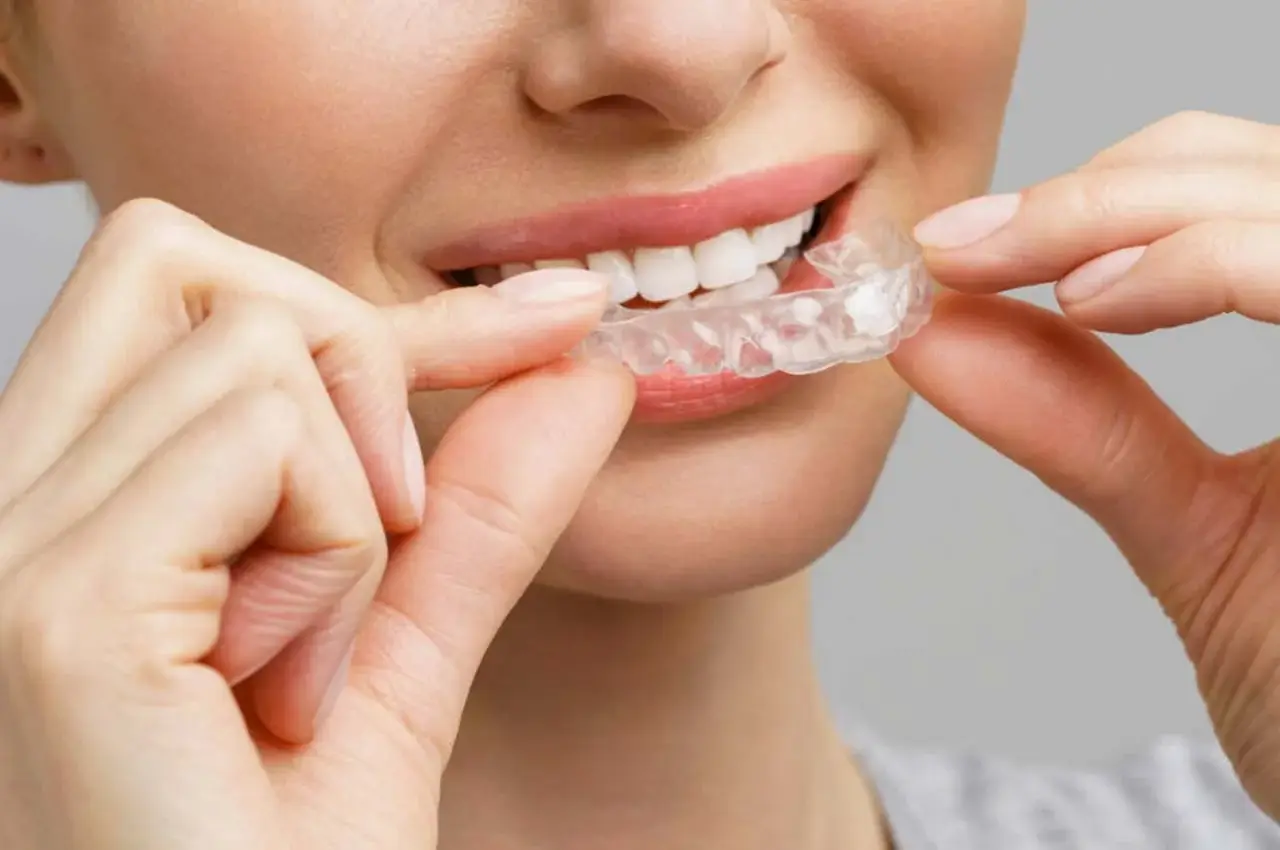
Aligners close the gap by moving the teeth into it. A series of clear removable trays applies gentle pressure, each one moving the teeth a fraction of a millimetre, until the space is gone. Nothing is added to the teeth and no enamel is removed.
That is the fundamental advantage and it is a significant one. At the end of treatment you still have your own unmodified teeth, just in different positions. There is no material to stain, chip or replace in fifteen years, and no maintenance beyond retention.
The trade-off is time and discipline. Closing a simple midline gap typically takes a few months; a case involving wider alignment takes considerably longer. The trays must be worn twenty to twenty-two hours a day, and patients who wear them inconsistently get inconsistent results. For someone travelling for treatment, the review appointments need planning around. How clear aligner treatment works covers the practicalities.
The point everybody underestimates is retention. Teeth have memory and will drift back towards their original position if nothing holds them. A retainer — usually a thin wire bonded behind the front teeth — is not optional after orthodontic closure. Skipping it is the single most common reason a gap returns.
Option Four — Fixed Braces
Conventional braces do the same job as aligners with more force and more control. For a straightforward midline gap they are rarely the first suggestion in an adult, but there are cases where they remain the better tool.
Braces excel when teeth need bodily movement — shifting the whole root rather than tipping the crown — and when the gap is part of a larger alignment problem involving rotations or bite correction. They are also fixed in place, which removes compliance from the equation entirely.
The obvious cost is appearance and comfort over the treatment period, though ceramic brackets and lingual braces placed behind the teeth mitigate the first considerably. Cleaning is more demanding, and patients with a tendency to decay need to be honest with themselves about that before starting. The braces versus aligners comparison goes through the cases where each wins.
For an isolated midline gap in an adult, braces are usually more appliance than the problem requires. Where they earn their place is when the gap is one feature of a broader picture — crowding elsewhere, a rotated neighbour, or a bite that does not meet correctly. In those cases closing the gap alone would leave the real problem untouched, and the wider alignment question has to be answered first.
The Frenum Question
If a low frenum attachment is holding the gap open, none of the four methods above will hold on its own. The tissue simply pushes the teeth apart again, and the patient is left assuming the treatment failed.
Checking for it is quick — the dentist lifts the upper lip and watches whether the tissue between the front teeth blanches. If it does, the frenum is inserting between the teeth rather than above them.
The correction, a frenectomy, is a short procedure under local anaesthetic that releases the attachment. Where orthodontics is planned, it is normally done after the teeth have been moved together rather than before, because the resulting scar tissue actually helps hold the closure. Where bonding or veneers are planned, it is done first.
This is the step most often skipped in quick cosmetic consultations, and it is the reason a proportion of closed diastemas reopen. If nobody has looked at your frenum before proposing a treatment plan, ask.
Comparing the Four Options
| Bonding | Veneers | Aligners | Braces | |
|---|---|---|---|---|
| Enamel removed | None | Yes, permanent | None | None |
| Teeth actually move | No | No | Yes | Yes |
| Typical duration | One visit | 2–3 visits | Several months | Longer |
| Reversible | Yes | No | Yes | Yes |
| Maintenance | Polish and repair | Replace eventually | Retainer for life | Retainer for life |
| Best for gaps up to | About 2 mm | Larger, with reshaping | Any size | Any size, complex cases |
| Changes tooth colour | Yes, if wanted | Yes, fully | No | No |
The row worth pausing on is "teeth actually move". Bonding and veneers close the space by making the teeth wider; orthodontics closes it by bringing them together. If your teeth are already a normal width for your face, widening them further is a compromise — and if they are narrow, adding width is the more natural-looking answer. That single question resolves most cases.
Cost follows the same pattern as elsewhere in dentistry: the cheapest option up front is rarely the cheapest over twenty years. Bonding needs polishing and periodic replacement, veneers eventually need remaking, and orthodontics needs only a retainer. We do not publish price lists — the four methods differ too much in scope for a number to mean anything before assessment — but the long-run pattern is worth holding in mind when comparing quotes. What to check in any quote covers this.
How to Choose
- Establish whether the gap is new. If it opened in adulthood, the cause comes before the cosmetics. Nothing else on this list matters until that is answered.
- Measure it. Under two millimetres opens up bonding as a straightforward option. Above that, either orthodontics or a wider restorative plan.
- Assess tooth width. If your front teeth are already broad, widening them further will look wrong. Move them instead.
- Decide about enamel. If preserving natural tooth structure matters to you, that rules veneers out and points to aligners or bonding.
- Be honest about time. Aligners take months and require discipline. Bonding takes an afternoon. Both are legitimate; the wrong choice is committing to one while wanting the other.
There is a hybrid worth knowing about. Aligners first to bring the teeth close together, then minimal bonding to perfect the contact points, gives an excellent result with far less material than bonding alone — and without removing any enamel. It costs more than either treatment separately and is often the best answer for a large gap in a patient who wants to keep their own teeth.
What the Gap Is Doing to Your Bite
A midline space is usually harmless, but there is one situation worth checking. If the upper front teeth have splayed outwards to create the gap, they are no longer contacting the lower teeth the way they were designed to, and the guidance that protects the back teeth during side-to-side movement is lost.
The consequence is gradual. Back teeth that should separate slightly when you move your jaw sideways stay in contact instead, grinding against each other. Over years this produces flattened cusps, sensitivity and occasionally cracks in otherwise sound molars. Patients rarely connect the two, because the gap is at the front and the damage is at the back.
This is one reason closing a splayed gap with bonding alone can be an incomplete answer. Adding material to the front surfaces makes the space disappear visually without restoring the guidance, because the teeth themselves are still angled outwards. Bringing them back into position with aligners restores both.
It is worth asking specifically whether your bite has been assessed, not just your appearance. A few minutes checking how the teeth meet in different jaw positions distinguishes a purely cosmetic gap from one that is part of a larger pattern — and that changes which of the four options is genuinely right. Grinding and its effects often show up in the same examination.
Keeping It Closed
Whatever method is used, a closed gap has a tendency to reopen, and the reasons differ by method. Understanding which applies to you decides the maintenance.
After orthodontic closure, relapse is the risk and retention is the answer. A bonded wire behind the front teeth is the standard, checked periodically because the bond can fail silently. Removable retainers work if worn; they usually end up in a drawer within two years, and the teeth respond accordingly.
After bonding or veneers, the risk is different — the material chips or stains rather than the teeth moving. That is a maintenance schedule rather than a failure, and it should be quoted as such from the outset.
In both cases, if the original cause was gum disease or a missing back tooth, the underlying condition determines whether anything holds. Teeth continue to drift while bone is being lost, no matter what is bonded to their front surfaces.
How We Decide Between Closing and Aligning
The consultation begins by establishing when the gap appeared and whether anything is still driving it. That means checking gum health, looking at what is happening further back in the arch, and examining the frenum — three things that take a few minutes and change the plan more often than patients expect.
Where the gap is longstanding and purely cosmetic, we set out all four options with their trade-offs rather than leading with the most involved one. A two-millimetre gap in a patient with narrow front teeth genuinely does not need veneers, and we will say so.
Our clinic has treated patients from more than thirty countries over twelve years. All treatments carry a lifetime guarantee, provided the recommended check-ups are attended and the aftercare followed, and excluding accidental damage or neglect. For orthodontic closure that specifically includes wearing the retainer — without it, relapse is not a treatment failure but a predictable consequence. If you are travelling for treatment, how the visits are structured is worth reading first.