










What Each Material Actually Is
Lithium disilicate is a glass-ceramic. A glass matrix holds needle-shaped crystals through it, and that structure is what gives it both strength and optical behaviour close to natural enamel. It is usually referred to by its best-known trade name, and it has been in routine use for over two decades.
Zirconia is a polycrystalline ceramic — zirconium dioxide, stabilised with yttrium. There is no glass phase in it at all, and that is precisely why it is so much stronger and, in its original forms, so much more opaque. Light behaves differently in a material with no glass in it.
The mechanical difference is large rather than marginal. Zirconia's flexural strength is several times that of lithium disilicate, which is why it can span a bridge and survive molar loading where a glass-ceramic would fracture.
The optical difference runs the other way, and it is equally real. Lithium disilicate transmits and scatters light much as enamel does, which is what makes a front restoration look alive rather than applied. Early zirconia looked like what it is: a dense white ceramic.
Everything in the rest of this comparison follows from those two facts. Neither material is better; they are optimised for opposite ends of the same mouth.
Zirconia Is Not One Material
This is the part most often missed, and it matters more than the choice between the two families. Zirconia has developed through several generations, and they differ from each other more than lithium disilicate differs from some of them.
First-generation zirconia was extremely strong and extremely opaque, and it was used as a substructure with porcelain layered over it for appearance. Strong, and dependent on that layered porcelain, which could chip away from the core.
Later generations traded some strength for translucency by changing the crystal structure. The most translucent versions approach glass-ceramic in appearance and sit closer to it in strength as well — somewhat stronger than lithium disilicate, but well below the original zirconia.
Monolithic zirconia — milled as one solid piece with no layered porcelain — is now the standard for back teeth. Nothing can chip off it because nothing is layered onto it, and its surface is polished rather than glazed over a core.
So the useful question is not "zirconia or E-max" but "which zirconia, and why that one for this tooth." A quote saying only "zirconia crown" has not answered it — the differences between the generations sets out what to ask.
Zirconia and E-max Compared, Line by Line
The table compares lithium disilicate with monolithic zirconia, which is the practical choice most patients are actually deciding between. Layered zirconia sits between them on appearance and below monolithic on chip resistance.
| Lithium disilicate (E-max) | Monolithic zirconia | |
|---|---|---|
| Structure | Glass-ceramic with crystals | Polycrystalline, no glass phase |
| Strength | Good — suitable for single front units | Very high — molars and bridges |
| Translucency | Close to natural enamel | Lower, improving with newer generations |
| Best position | Front teeth, veneers, single crowns | Molars, premolars, bridges |
| Bridges | Short spans only | Long spans possible |
| Tooth removal | More — needs thickness for strength | Less — strong in thin sections |
| Chipping | Possible under heavy load | Very rare — nothing layered to chip |
| Wear on opposing teeth | Similar to enamel | Low if polished; higher if left rough |
| Bonding | Etched and bonded — very strong | Cemented; bonding protocol differs |
| Suits grinding | Less well | Better, with a night guard either way |
Read the tooth removal row alongside the strength row. Zirconia's strength in thin sections is a genuine conservation advantage, and it is rarely mentioned in comparisons that focus only on appearance.
The polishing row deserves attention too. Well-polished zirconia is kind to the opposing teeth; poorly finished zirconia is abrasive, and that is a workmanship issue rather than a material one.
Where Lithium Disilicate Belongs
Front teeth, in almost every case where a single unit or a veneer is being made and the tooth underneath is not badly discoloured. The material's optical behaviour is what makes the restoration disappear next to natural neighbours.
Veneers specifically. A thin veneer bonded to enamel relies on the bond for its strength, and lithium disilicate etches and bonds exceptionally well — the bonded restoration is considerably stronger than the ceramic alone. That combination is what makes minimal-preparation veneers possible.
Single crowns on premolars, where appearance still matters because they show in a wide smile, and loads are moderate rather than extreme. This is the boundary region where either material can be defended and the bite assessment decides.
Where it does not belong is molars in a heavy bite, long-span bridges, and patients who grind and will not wear a guard. In those situations it is being asked to do a job zirconia does better, and the failure mode is fracture.
It is also the wrong choice over a severely discoloured or metal-post tooth. Translucency works both ways: a material that transmits light beautifully also transmits what is underneath it, and masking requires opacity.
Where Zirconia Belongs
Molars, without much argument. The loads there are several times those at the front, appearance matters far less, and monolithic zirconia handles both facts. It is the standard posterior material for good reasons.
Bridges of any meaningful span. A bridge concentrates force through connectors between units, and that is where fractures start. Zirconia's strength is what makes longer spans predictable rather than optimistic.
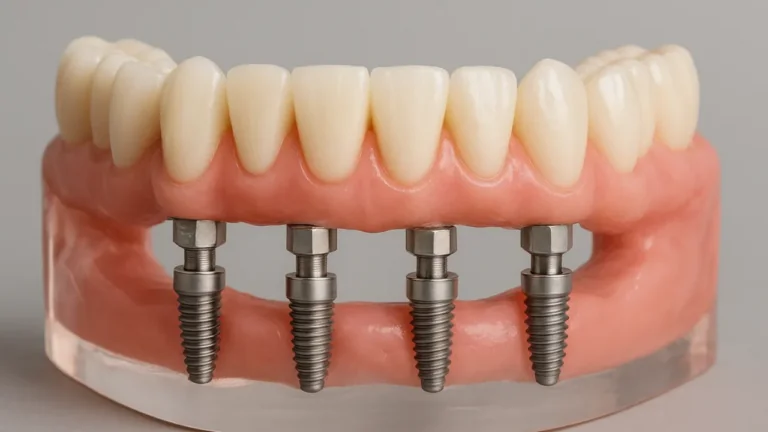
Implant crowns and full-arch implant bridges, where the restoration has to last decades under load with no ligament to cushion it. An implant does not have the shock absorption a natural tooth's ligament provides, which raises the demand on the material above it.
Patients who grind, in any position. Ceramic placed on an unmanaged grinding habit fails whatever it is made of, but zirconia survives considerably longer while the habit itself is addressed — and the night guard remains part of the plan.
And any case where tooth conservation is the priority. Because zirconia is strong in thin sections, less enamel has to be removed than for a layered restoration, which on a young tooth is a meaningful argument.
Full-arch implant bridges are the most demanding version of this. A fixed arch on four to six implants concentrates the whole bite through a small number of supports, and monolithic zirconia is what makes that span reliable over decades.
The Front Teeth Problem
This is where the choice becomes genuinely difficult, and where most disagreements between clinicians sit. Front teeth need to look natural and they still need to survive, and the ideal material for each requirement is different.
For most front cases lithium disilicate wins, because the loads are manageable and the appearance requirement dominates. A well-made front veneer or crown in glass-ceramic is very difficult to identify as a restoration.
The exceptions are specific. A severely darkened tooth needs opacity to mask it. A patient with an edge-to-edge bite loads the front teeth like back teeth. A heavy grinder does the same. In those cases zirconia, in a translucent generation, is the safer answer.
There is a hybrid worth knowing about: a zirconia core with a thin layer of glass-ceramic on the visible surface only. It gives depth where it is seen and strength where it is loaded, and it is a genuine option rather than a compromise.
The decision belongs in the design conversation rather than in a materials list. How material choice fits into the wider plan sets out where it sits alongside shade, proportion and preparation.
Tooth Removal Compared
This is the argument that should carry more weight than it usually does, because it is the only part of the decision that is irreversible.
A layered restoration needs thickness: enough for the core plus enough for the porcelain over it. That thickness has to come from somewhere, and it comes from the tooth. Older layered zirconia crowns required substantial preparation for exactly this reason.
Monolithic zirconia is strong in thin sections, so a crown can be made considerably thinner and still be reliable. On a molar that can mean noticeably less reduction of the occlusal surface, which is enamel kept rather than removed.
Lithium disilicate sits between the two. It needs more thickness than monolithic zirconia for equivalent reliability, but it bonds so well to enamel that a bonded veneer can be very thin indeed — thinner than any crown, in any material.
So the ranking by conservation depends on the restoration type rather than the material alone. A bonded glass-ceramic veneer removes least; a monolithic zirconia crown removes less than a layered one; a layered crown removes most — as the coverage comparison sets out.
Bonding and Cementation Differ
How each material attaches to the tooth is a technical point with a practical consequence, and it is one of the reasons the two behave differently in service.
Lithium disilicate is etched with hydrofluoric acid, treated with a silane coupling agent, and adhesively bonded. That bond is chemical as well as mechanical, and the resulting restoration is stronger bonded than it is as a standalone piece of ceramic.
Zirconia cannot be etched in the same way, because there is no glass phase for the acid to attack. It is prepared by air abrasion and a phosphate-containing primer, and it is usually cemented rather than adhesively bonded — which is adequate, because it does not need the bond for strength.
The practical consequence is that lithium disilicate depends on good enamel to bond to. On a tooth with little enamel left, the bond is weaker and the restoration less reliable, which pushes the decision towards zirconia.
It also means technique matters. A glass-ceramic veneer bonded without proper isolation and surface treatment is a restoration waiting to debond, and that is a workmanship variable rather than a material one — most debonding failures trace back to it.
Wear on the Opposing Teeth
A common concern, frequently overstated, and worth understanding properly because the answer is about finishing rather than about the material.
The old objection was that zirconia is harder than enamel and therefore wears the teeth it bites against. The research is clearer now: well-polished zirconia wears opposing enamel no more than natural enamel does, and in some studies less.
What does cause wear is a rough surface. Zirconia that has been adjusted chairside and not repolished is abrasive, and glazed zirconia becomes abrasive once the glaze wears through. Polishing is not a finishing touch here — it is a clinical requirement.
Lithium disilicate behaves similarly to enamel and raises the question less often. Layered porcelain over a zirconia core is the configuration with the worst record, which is another argument for monolithic restorations at the back.
If a crown is adjusted at the bite check, ask that it be polished afterwards. It takes minutes and it is the difference between a restoration that is kind to the opposing tooth and one that is not.
Longevity and How Each Fails
Both last a long time when correctly chosen and well made. Where they differ is in how they end, and knowing that tells you what to protect.
Lithium disilicate fails by fracture, and almost always because of force: a heavy bite, a grinding habit, a restoration placed in a position that loads it beyond what glass-ceramic tolerates. The ceramic does not degrade; it breaks or it does not.
Monolithic zirconia rarely fractures. When it fails, it is usually because of what is happening underneath — decay at the margin, or a fracture in the tooth itself. The crown is frequently intact when it is removed.
Layered restorations have a third failure mode that monolithic ones do not: the porcelain chipping away from the core. It is the main reason layered zirconia has largely given way to monolithic at the back.
Whichever is used, our restorations carry a lifetime guarantee on materials and workmanship, in writing — what is covered and what is not states the exclusions plainly rather than burying them.
Cost, and Why the Difference Is Smaller Than Expected
Material cost is a modest part of what a restoration costs. The larger part is laboratory time, and that varies more with how the restoration is made than with what it is made from.
A monolithic zirconia crown is milled from a block and finished. A layered restoration is built up by hand over hours. A hand-layered veneer designed to reproduce the translucency gradient of a natural tooth takes longer still. Those differences dominate the figure.
That is why two quotes both saying "zirconia crown" can differ substantially and both be honest. One may be a milled monolithic crown finished in an hour; the other a layered restoration with characterisation built in.
It is also why asking which material is only half the question. Ask how it is made and whether the technician sees you for shade — those answers explain the figure better than the material name does.
How the lines break down in a full quote is set out in the zirconia crown breakdown and the veneer breakdown, both structured so two proposals can be compared honestly.
The same logic applies to single crowns anywhere in the mouth. How a crown is quoted depends far more on how it is made and who makes it than on which ceramic block it was milled from.
Questions That Establish What You Are Being Offered
Five questions, all answerable immediately by a clinic that has made the choice deliberately. Vagueness in the answers is the finding, not the inconvenience.
- Which material for each tooth, and why that one for that position?
- If zirconia — which generation, and monolithic or layered?
- Who makes it, and will the technician see me for shade?
- How much preparation does this material require on this tooth?
- If it is adjusted at the bite check, will it be repolished?
The second question is the most revealing. A clinic that answers "zirconia" and stops has either not made the choice or is not able to explain it, and the generations differ enough that it matters.
The fourth question connects the material choice back to the irreversible part of the decision. A material that needs less preparation is a material that keeps more of your tooth, and that is worth weighing alongside appearance.
Ask them while the plan is being written rather than on the day — where these fit in a consultation sets out the rest of what should be established at that stage.
How We Choose at Bağcılar
By position, by load and by what the tooth underneath looks like — never by a single material applied across a whole plan. A treatment plan here commonly names two or three different ceramics for different teeth, and each one has a reason written next to it.
Front teeth in a normal bite receive glass-ceramic, because appearance dominates and the loads permit it. Molars and bridges receive monolithic zirconia. Premolars are decided from the bite assessment, since they are visible and loaded.
Where a tooth is severely discoloured, or where an edge-to-edge bite or a grinding habit loads the front teeth heavily, the front choice moves to a translucent zirconia or a hybrid — and the reason for the change is explained rather than simply applied.
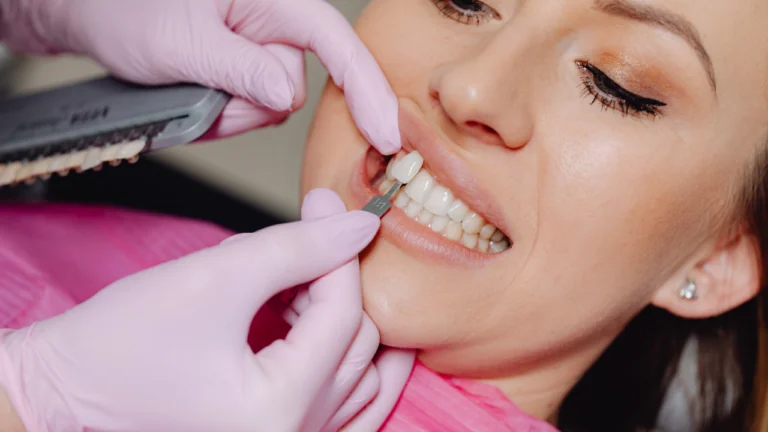
The laboratory is in the building and the technician sees you in person for shade, which is what makes a layered restoration worth specifying at all. Shade corrections happen the same day instead of across a courier cycle.
Every restoration carries a lifetime guarantee on materials and workmanship, in writing, whichever ceramic is used — how the crown process runs from start to finish sets out each stage.