












Why a Missing Tooth Is More Than a Gap
A natural tooth root does a job most people never think about: every time you chew, it transmits force into the jawbone, and that stimulation tells the bone to maintain itself. Remove the root and the signal stops. The bone in that spot begins to resorb — the body simply reclaims material it no longer considers necessary. Most of the loss happens in the first year, and it is measured in millimetres of both width and height.
That shrinking ridge causes a chain of problems. The teeth beside the gap lose the support they used to lean against and start to tip sideways. The tooth in the opposing jaw, with nothing to bite against, over-erupts and drops into the space. Your bite changes shape, which loads some teeth harder than they were designed for and can start cracking them years later.
There are practical consequences too. A gap in the chewing surface pushes you to favour one side, which strains the jaw joint on that side. Food traps around tilted teeth and is harder to clean, which raises the risk of decay and gum problems in exactly the teeth you most need to keep. If the missing tooth is visible when you speak, most people also change how they smile without noticing.
None of this argues for panic. It argues for deciding within a reasonable window rather than in five years, because bone that is still there is far easier to work with than bone that has to be rebuilt with a graft.
What Happens If You Leave It
Doing nothing is a legitimate option in some situations, and it is worth being clear about when. A missing wisdom tooth needs no replacement at all — it has no functional role for most people. A single missing molar right at the back, with healthy teeth in front of it and no opposing tooth to over-erupt, sometimes needs nothing more than monitoring.
Outside those cases, leaving the gap has a predictable trajectory. In the first one to two years you lose the most bone width. Over three to five years the neighbouring teeth tilt enough that they no longer sit upright, which matters because an implant placed later needs a straight path into the bone and a properly shaped space above it. Orthodontic work may then be needed just to reopen a space that used to be the right size.
The financial side is counter-intuitive. Waiting does not save money; it usually adds a step. A straightforward implant becomes an implant plus a graft, or plus a sinus lift in the upper back jaw where the sinus drops into the space left by a lost molar. Each added step means more time, more cost and a longer healing period.
If you have already waited a long time, this is not a reason to give up. Modern grafting and zygomatic implant techniques have made cases treatable that would have been declared hopeless fifteen years ago. It simply means the plan gets longer.
Option One — A Single Dental Implant
An implant is a titanium post placed into the jawbone in the position of the old root, left to integrate with the bone, and then fitted with a crown. It is the only option that replaces the root as well as the visible tooth, which is why it is the only one that keeps the bone stimulated and stops the ridge from shrinking further.
The main advantage is that nothing is done to the healthy teeth around it. A bridge borrows support from its neighbours; an implant stands alone. If the teeth either side of your gap are untouched and healthy, most dentists will argue strongly against grinding them down to carry a bridge when an implant is possible.
The trade-off is time. Bone integration takes roughly three to six months depending on the site and your healing, so a conventional implant is not a single-visit solution. In selected cases where bone quality is good and the implant is stable at placement, immediate loading allows a temporary tooth on the same day, with the final crown fitted later.
Implant brands are not interchangeable, and this matters more than patients expect. The systems we work with are long-established ones, chosen for two reasons: decades of published outcome data, and components that will still be manufactured in fifteen years if a part ever needs replacing. Brand differences are covered separately.
Option Two — A Fixed Bridge
A bridge spans the gap by resting on the teeth either side. Those two teeth are prepared — reduced in size all the way around — and the bridge is cemented over them as a single connected unit, with the replacement tooth suspended in the middle. Nothing goes into the bone.
Its strengths are speed and predictability. A conventional bridge is usually finished in two visits over about a week, with no healing period, no surgery and no waiting for integration. For patients who cannot undergo minor surgery, who are on certain medications affecting bone, or who simply need the problem solved before a fixed date, that matters.
The cost is paid by the neighbouring teeth. Preparing a healthy tooth removes enamel permanently, and a proportion of prepared teeth eventually need root canal treatment because the nerve reacts badly to being trimmed. Because the three units are joined, they must be cleaned underneath with floss threaders or interdental brushes; ordinary flossing does not reach.
There is also the bone question. A bridge sits above the gum and does nothing for the bone underneath, so the ridge continues to shrink. After several years a visible dark triangle can open between the false tooth and the gum. That is cosmetic rather than dangerous, but it is the reason bridges are often remade sooner than their materials would strictly require. What a bridge costs depends mainly on the number of units.
Option Three — A Removable Partial Denture
A partial denture is a plate carrying one or more replacement teeth, held in place by clasps that grip the remaining natural teeth. It is taken out for cleaning and usually at night. It is by a wide margin the least invasive and least expensive way to fill a gap.
It genuinely suits some situations. When several teeth are missing in different parts of the mouth, a single partial denture can replace all of them at once where implants would mean several separate surgical sites. When bone is severely reduced and the patient does not want grafting, it may be the only fixed-cost option. It is also a sensible interim solution while bone heals after extractions and before implants are placed.
The honest downsides are stability and habit. A partial denture moves slightly when you chew, which changes what you can comfortably eat; hard and sticky foods are the usual casualties. Speech takes a week or two to adapt. The clasps are sometimes visible depending on where they sit. And because the plate rests on the gum rather than in the bone, the ridge underneath keeps resorbing — which means the denture gradually loosens and needs relining every few years.
Many patients treat a partial denture as a staging post rather than a destination, and there is nothing wrong with that. It buys time to plan and budget without leaving the gap open. Denture pricing varies mainly by material and by how many teeth the plate carries.
Option Four — Replacing a Whole Arch
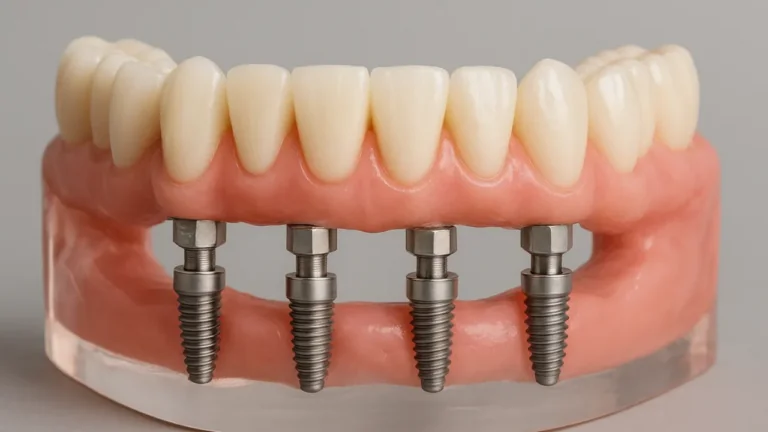
When most or all teeth in a jaw are missing or failing, the arithmetic changes. Replacing fourteen teeth with fourteen implants is neither necessary nor sensible. A full arch of fixed teeth can be carried on four to six implants, because the bridge that sits on top distributes chewing force across all of them.
The All-on-4 approach angles the two rear implants to anchor in the bone still available at the front of the jaw, often avoiding grafting entirely. Where bone allows, six implants spread the load further and give more margin if one implant ever fails. The trade-offs between the two are set out in the direct comparison.
A middle option is worth knowing about: an implant-retained overdenture. Two to four implants carry attachments that a denture clips onto. The denture is still removable, but it no longer slides — which for many people is the single biggest quality-of-life change — at a fraction of the cost of a fully fixed bridge.
Full-arch work is the most involved option on this page and the most transformative. It is also where planning matters most: bone volume, bite height, lip support and the position of the sinus and nerve all have to be assessed on a 3D scan before anything is decided. Full-arch cost is quoted per jaw, not per tooth.
The Options Side by Side
The table below compares the four routes on the factors patients actually weigh. Treat the timings as typical rather than guaranteed — healing varies, and any preparatory work such as extraction or grafting adds to the total.
| Single implant | Fixed bridge | Partial denture | Full-arch implants | |
|---|---|---|---|---|
| Touches healthy teeth | No | Yes — two are trimmed | Clasps rest on them | No |
| Preserves jawbone | Yes | No | No | Yes |
| Fixed or removable | Fixed | Fixed | Removable | Usually fixed |
| Typical treatment span | 3–6 months | About 1 week | 2–3 weeks | 3–6 months |
| Surgery required | Yes | No | No | Yes |
| Relative up-front cost | Higher | Medium | Lowest | Highest |
| Typical lifespan | Longest | Long | Shortest | Longest |
| Cleaning | Like a natural tooth | Threaders needed | Taken out daily | Special brushes |
One column deserves emphasis. "Relative up-front cost" and "typical lifespan" usually run in opposite directions, which is why comparing quotes on price alone is misleading. A bridge remade twice over twenty years is not cheaper than an implant placed once. Equally, an implant is not automatically better value if your circumstances mean you would not keep it that long.
Choosing by How Many Teeth Are Missing
The number and position of the gaps narrows the field faster than anything else. The following is how most treatment plans are reasoned through before any scan is taken.
- One tooth, healthy neighbours. An implant is the default recommendation, precisely because it leaves those healthy teeth alone. A bridge only makes sense here if surgery must be avoided.
- One tooth, damaged neighbours. If the teeth either side already need crowns, a bridge becomes efficient — they were going to be prepared anyway, so the bridge costs little extra work.
- Two or three in a row. Two implants can usually carry three teeth. Beyond that span, implant support is needed at both ends rather than a long unsupported section.
- Several scattered gaps. Either several implants or one partial denture. The decision is usually driven by budget and by how much the patient dislikes removable appliances.
- Most or all of an arch. Four to six implants with a fixed bridge, or two to four with a clip-on overdenture.
Position matters as much as number. Front teeth are judged on appearance — gum line, tooth shape, how the lip moves — and often need more careful soft-tissue work. Back teeth are judged on chewing force, and the upper back jaw brings the sinus into the picture.
What Decides Whether You Are a Candidate
Not everyone is suitable for every option, and a proper assessment checks four things before a plan is proposed.
- Bone volume and density. Measured on a 3D scan, not guessed from an ordinary X-ray. Thin or short bone does not rule out implants; it usually adds a grafting step.
- Gum health. Active gum disease must be treated before implants are placed. An implant in inflamed tissue is an implant at risk from day one.
- Smoking. It measurably raises implant failure rates by impairing healing. It is not an absolute bar, but it changes the risk conversation and any guarantee discussion.
- General health and medication. Uncontrolled diabetes, certain bone medications and recent radiotherapy to the jaw all affect healing and must be declared honestly at the assessment stage.
Bite habits are the fifth factor and the most often overlooked. Heavy grinding or clenching puts loads on restorations that they were not designed for, and it is a common reason work fails early. Where grinding is present, a protective night guard is part of the plan rather than an optional extra.
How Long Each Route Takes
Treatment time is often the deciding factor for patients travelling from abroad, so it is worth separating chair time from healing time. Healing does not require you to be in the country.
A conventional implant is typically two trips: a short first visit for placement, then three to six months of healing at home, then a second visit of a few days for the crown. A bridge is usually a single trip of five to seven days. A partial denture takes roughly two to three weeks of fittings, some of which can be compressed. Full-arch work is normally two trips, with a fixed temporary bridge worn in between.
Where extractions or grafting are needed, add a healing phase before the implant stage — usually two to four months for a simple socket, longer for a substantial graft. This is the main reason a plan that looks like "one week" on a price list becomes several months in reality, and it is better to know that at the start. Trip planning is covered in detail separately.
Questions Worth Asking Before You Decide
A good assessment should leave you able to answer all of the following. If it does not, the plan is not yet complete — wherever in the world you are treated.
- Which implant system will be used, and will its components still be available in fifteen years?
- Was the bone assessed on a 3D scan, and was grafting ruled in or out on that evidence?
- How many separate trips does the plan require, and what is worn in between?
- What exactly is covered if something fails, for how long, and what would invalidate it?
- What happens to the teeth either side under each option — are any healthy teeth being cut?
- What is the maintenance routine, and what does it cost each year?
A second opinion is reasonable and no competent clinic will be offended by it. What should concern you is a plan proposed without a 3D scan, a quote that cannot be itemised, or a recommendation that never mentions a trade-off. Every option on this page has one. What to check before choosing a clinic goes through this in more depth.